Four developments are hitting the German construction industry at once in 2026 and noticeably increasing sampling and analytical demand on sites: the stepwise PFAS restriction in REACH (for PFHxA and precursors through Regulation (EU) 2024/2462) together with the related drinking-water values from EU Drinking Water Directive 2020/2184; the Mantelverordnung with Substitute Building Materials Ordinance (Ersatzbaustoffverordnung, EBV) in force since August 2023; the asbestos investigation of existing buildings tightened by the 2024 Hazardous Substances Ordinance amendment; and political pressure to accelerate major infrastructure projects. Anyone who shifts soil and materials testing exclusively by courier to a stationary laboratory comes under logistical and planning pressure in this situation.
Why site laboratories pay their way on many projects in 2026
The construction industry faces four tightenings that, taken together, markedly increase the need for sampling and analysis on many sites.
1. PFAS in REACH and drinking water
Regulation (EU) 2024/2462 added the restriction of PFHxA and precursors to REACH Annex XVII (entry 79); in parallel, the PFAS requirements of EU Drinking Water Directive 2020/2184 apply. On sites with a history of foam extinguishing agents, electroplating or paper/textile industry use, the investigation demand for excavated material and leachate therefore rises sharply.
2. Substitute Building Materials Ordinance (EBV)
In force since 1 August 2023. Before mineral substitute building materials are placed, material-class-specific investigation is mandatory – for example for soil material (BM), recycled construction materials (RC-1/2/3), track ballast (GS), steelworks slag (SWS) and municipal solid-waste incinerator ash (HMVA). Eluate and solid-matter analysis become a standard process on every larger earthworks site.
3. Asbestos investigation of existing buildings
The 2024 GefStoffV amendment spelled out the commissioning party’s information and co-operation duties and the employer’s investigation duties for work on older building fabric. Which protective measures under TRGS 519 apply in the individual case – dirty/clean area, airlock, H-class vacuum – depends on the activity and expected exposure; container concepts can map these requirements in the building fabric.
4. Infrastructure acceleration
The Measures Act Preparation Act, LNG Acceleration Act and Energy Industry Act amendment: rail, bridge and power-line projects are under considerable time pressure. Long waits for external stationary-laboratory results are barely tolerable in tightly sequenced construction programmes.
What a modern site laboratory must cover
A professional site laboratory serves three testing domains in parallel: concrete and asphalt testing (ongoing construction), soil and geotechnics (earthworks, backfill, sub-base) and contaminant analysis (asbestos, PFAS, hydrocarbons, heavy metals). Which configuration makes sense depends on the project type.
| Project type | Concrete/asphalt | Soil/geotechnics | Contaminants |
|---|---|---|---|
| Residential building | ●●● | ●● | ● |
| Industrial building | ●●● | ●● | ●● |
| Tunnels & civil engineering | ●●● | ●●● | ●● |
| Road construction | ●●● | ●●● | ● |
| Bridge construction | ●●● | ●● | ● |
| Refurbishment of existing buildings | ● | ● | ●●● |
| Contaminated-land remediation | – | ●● | ●●● |
| Airport / military | ●● | ●● | ●●● |
● = occasional · ●● = regular · ●●● = daily core process
Concrete and asphalt testing: close to the point of placing
Fresh concrete changes its properties from the moment of mixing. Sampling and testing follow the DIN EN 12350 series, with precise rules for the time between sampling and testing. Transport to a distant stationary laboratory shortens the available testing window and is one of the main reasons contractors have relied on on-site testing for decades.
Fresh-concrete tests in the container (DIN EN 12350)
- Part 1Sampling – uniform rules for taking samples from mixer, delivery vehicle or pump
- Part 2Slump with Abrams cone – consistency classes S1 to S5
- Part 3Vebe time – consistency test for very stiff concretes
- Part 4Degree of compactability after Walz – classes C0 to C3
- Part 5Flow table / spread – classes F1 to F6, typical for pumped concretes
- Part 6Fresh-concrete density with calibrated container and precision balance
- Part 7Air content by the pressure method
- Parts 8–12Self-compacting concrete: slump-flow (Part 8), V-funnel (Part 9), L-box (Part 10), sieve segregation / segregation resistance (Part 11), J-ring (Part 12)
Hardened-concrete tests to DIN EN 12390 follow standard-compliant specimen curing – compressive strength to Part 3 is the most common commission. Contractors need the 7-day and 28-day values in time for construction-programme planning. A container laboratory with a 3,000 kN press, curing to DIN EN 12390-2 (under water or in a moist room at 20 ± 2 °C) and 150 × 150 × 150 mm cube moulds delivers these values without a logistics break.
For factory production control (WPK) of concrete production to DIN EN 206 / DIN 1045-2 and for construction execution to DIN 1045-3 in supervision classes ÜK 1 to ÜK 3, a corresponding testing density is mandatory in any case. On major sites with their own batching plant, the container becomes a permanent measurement and documentation centre.
Soil and geotechnics: DIN 18130 and 18134 on site
Earthworks is the second major application domain. Plate load tests to DIN 18134 provide the deformation moduli Ev1 and Ev2 – the most important characteristic values for the bearing capacity of formation and sub-bases. A static plate load tester (PDG) and a light falling-weight deflectometer (LFG to TP BF-StB B 8.3) belong in every serious site laboratory.
DIN 18130 Part 1 governs determination of the coefficient of permeability (k-value) in the laboratory – relevant for leachate systems, landfill liners and infiltration installations. In addition: DIN 18127 Proctor test for optimum compaction, DIN 18121 water content, DIN 18123 particle-size distribution by dry and wet sieving. All methods can be performed in the container – standard equipment covers them.
Standard geotechnical equipment in the container
Field tests
- • Static plate load tester PDG ø 300 mm
- • Light falling-weight deflectometer LFG 10 kg
- • Densimeter / sand-replacement apparatus DIN 18125-2
- • Core drill
Laboratory tests in the container
- • Proctor apparatus A and C to DIN 18127
- • Sieve set 0.063 to 63 mm
- • Drying oven 105 °C
- • Casagrande apparatus (consistency limits DIN 18122)
Asbestos analysis: applying TRGS 519 with discrimination
With the 2024 Hazardous Substances Ordinance amendment and TRGS 519 “Asbestos – demolition, renovation and maintenance work”, the commissioning party’s information and co-operation duties and the employer’s investigation duties for work on older building fabric were spelled out. Before renovation and demolition of existing buildings, a stock investigation matched to the project and the risk is envisaged – the type and depth of investigations (renders, fillers, tile adhesives, floor coverings, etc.) depend on the specific project and the expected exposure.
TRGS 519 regulates protective measures for work with asbestos, graded by activity and expected exposure. Which specific measures – a delimited dirty/clean area, personnel airlock, H-class vacuum to EN 60335-2-69 Annex AA, negative-pressure hold, Category III Type 5/6 protective suit – apply in the individual case depends on method and expected exposure. Container laboratories can be configured for the activities actually planned – airlock, dirty area, clean area and sample issue can be clearly separated in the building fabric.
On-site microscopic pre-analysis
In container operation, optical-microscopic screening of material samples with a stereo and polarising microscope is possible – often within a few hours rather than several days of shipping. A first indication is therefore frequently available on the sampling day itself. Definitive material testing for asbestos in technical products and building components follows the VDI 3866 series (in particular Sheet 5 for SEM/EDX on material samples).
Quantitative fibre counting is then carried out by SEM/EDX – for example to VDI 3492 for air samples – in the accredited stationary laboratory. It makes sense to send only samples classified as suspect; that can noticeably relieve stationary-laboratory throughput.
PFAS screening: pre-analysis before excavated material is moved
PFAS (per- and polyfluorinated alkyl substances) are addressed by several EU legal acts: the EU Drinking Water Directive 2020/2184 with parameters for 20 PFAS individual substances and total PFAS, and the stepwise inclusion of individual PFAS substances in REACH Annex XVII – for example via Regulation (EU) 2024/2462 for PFHxA and precursors (entry 79). In construction, the sites of most relevance are those with a history of foam extinguishing-agent use (airports, military grounds, fire-service training areas), electroplating, and former paper and textile industry sites. Where there is a justified suspicion, excavated material must be investigated before recovery or disposal under the relevant waste and soil-protection rules.
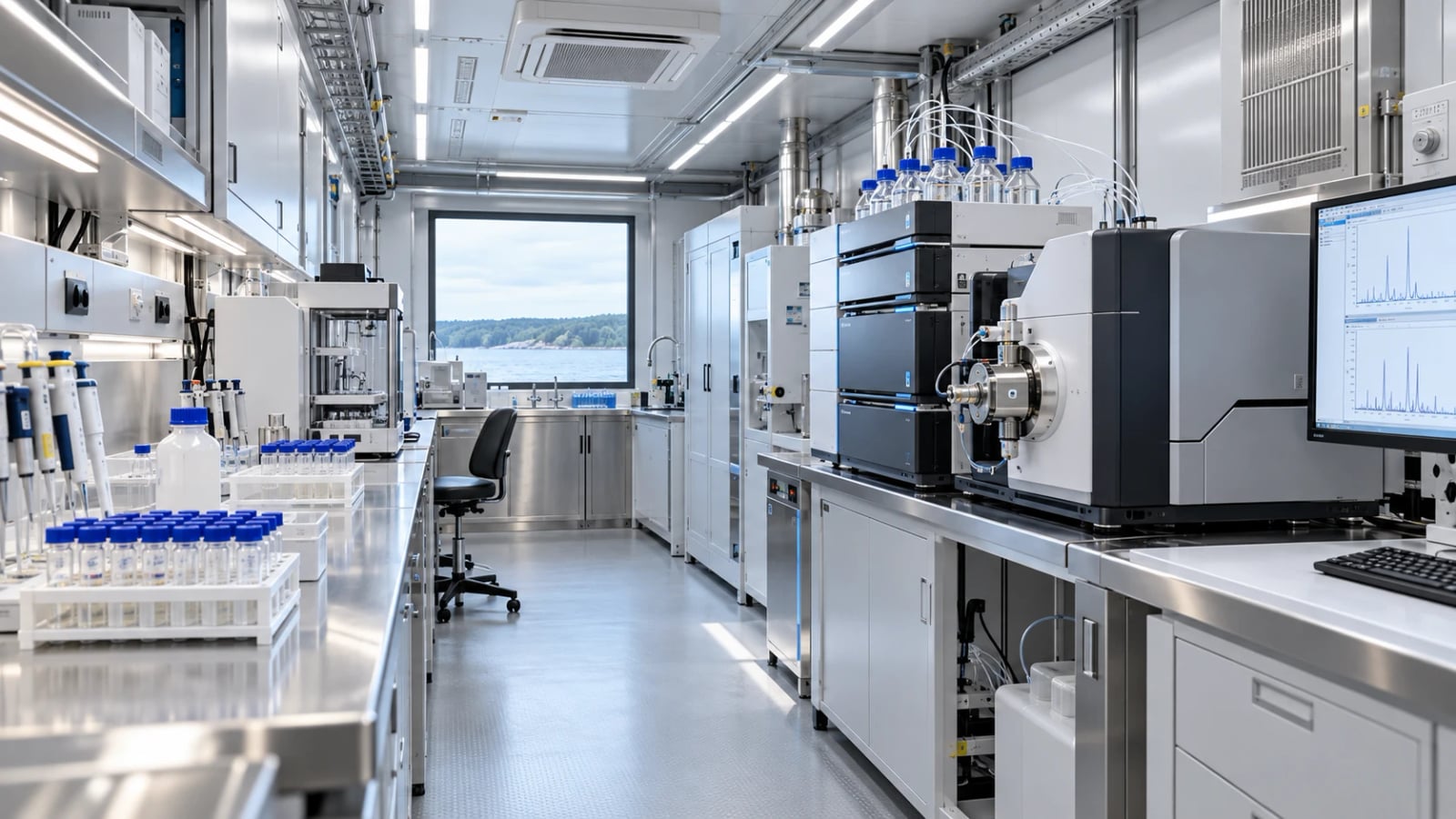
Quantitative determination is generally by LC-MS/MS in accredited stationary laboratories – in a mobile site container that moves between locations, this class of instrument is not usually practical. A permanently installed lab container designed for its climate requirements can house LC-MS/MS, however; see PFAS analysis in a lab container. What is practicable in a site laboratory, by contrast, is sample preparation (solid-phase extraction, SPE), a pre-analysis with suitable rapid tests, and accompanying parameters such as TOC, AOX, pH and conductivity. A first risk indication can therefore often be obtained promptly at the excavation before confirmatory analysis is commissioned in a targeted way.
For demolition and remediation sites with a PFAS suspicion, such an on-site pre-analysis step can simplify logistics: suspect soil stays on site for the time being, and shipments to the stationary laboratory are concentrated on robust suspect cases.
Standard equipment of a fully specified site laboratory
The following list summarises the equipment that a universal site laboratory covers. The LABtoGO, with a 9,500 × 3,000 mm footprint and 2,750 mm internal height, offers enough space for all stations without stacking or offloading instruments.
Concrete & mortar
- 3,000 kN press
- Flow table DIN EN 12350-5
- Abrams slump cone
- 8 L air-content meter
- 150 mm cube moulds
- Cylinder moulds ø 150/300
- Grinding machine
- Specimen curing to DIN EN 12390-2 (water or moist-room curing 20 ± 2 °C)
Soil & earthworks
- Plate load tester PDG
- Light falling-weight deflectometer
- Proctor apparatus A + C
- Sieve set 0.063–63 mm
- Casagrande apparatus
- Drying oven 105 °C
- Water bath
- Densimeter
Contaminants & environment
- Polarising microscope
- Stereo microscope
- H-class vacuum
- Personnel airlock
- Portable XRF
- SPE unit for PFAS
- pH/conductivity/TOC measuring station
- Asbestos containment housing
Permitting framework: site facilities in the state building codes (LBO)
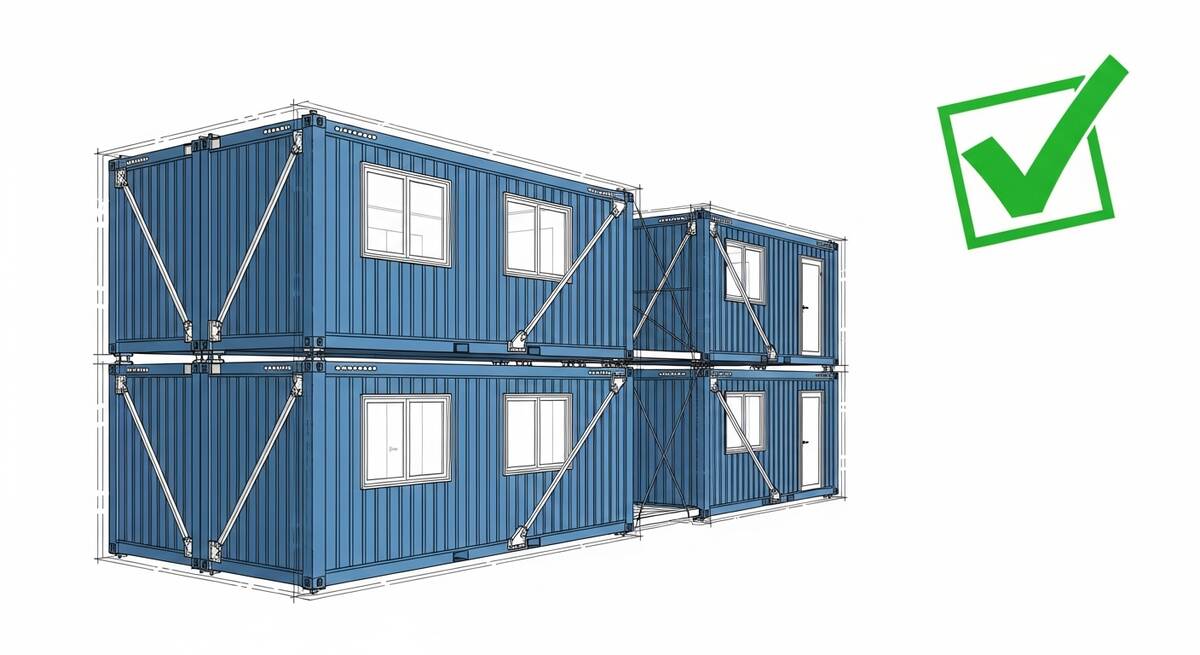
Containers that serve solely the execution of the works and are sited only for the duration of the construction project are regularly listed in the German state building codes (Landesbauordnungen) as procedure-exempt developments – often together with site huts, site cabins and sanitary containers. The exact citation (section, annex, item number) varies from Land to Land and changes with every LBO amendment. The following overview shows typical locations but does not replace a case-by-case check.
| Federal state (Land) | Typical citation |
|---|---|
| Baden-Württemberg | §50 LBO in conjunction with the annex (procedure-exempt developments) |
| Bavaria | Art. 57 BayBO (procedure-exempt building projects) |
| Berlin | §61 BauO Bln (procedure-exempt building projects / site facilities) |
| Hamburg | §60 HBauO (procedure-exempt developments) |
| Hesse | §63 HBO (procedure-exempt developments) |
| Lower Saxony | §60 NBauO in conjunction with the annex |
| North Rhine-Westphalia | §62 BauO NRW (permit-exempt developments) |
| Rhineland-Palatinate | §62 LBauO RP (procedure-exempt developments) |
| Saxony | §61 SächsBO (procedure-exempt developments) |
Overview for orientation. What matters is the currently applicable version of the LBO including the annex. The condition in every Land: spatial connection to the site, no residential use, no permanent siting beyond the construction period.
Important: as soon as the container is to remain after completion or to be used as a permanent testing laboratory, a building-permit application is generally required. We check in advance, for each federal state and location, in which constellation procedure-exemption can be assumed – and support liaison with the competent building authority.
Logistics: siting, services, relocation between construction phases
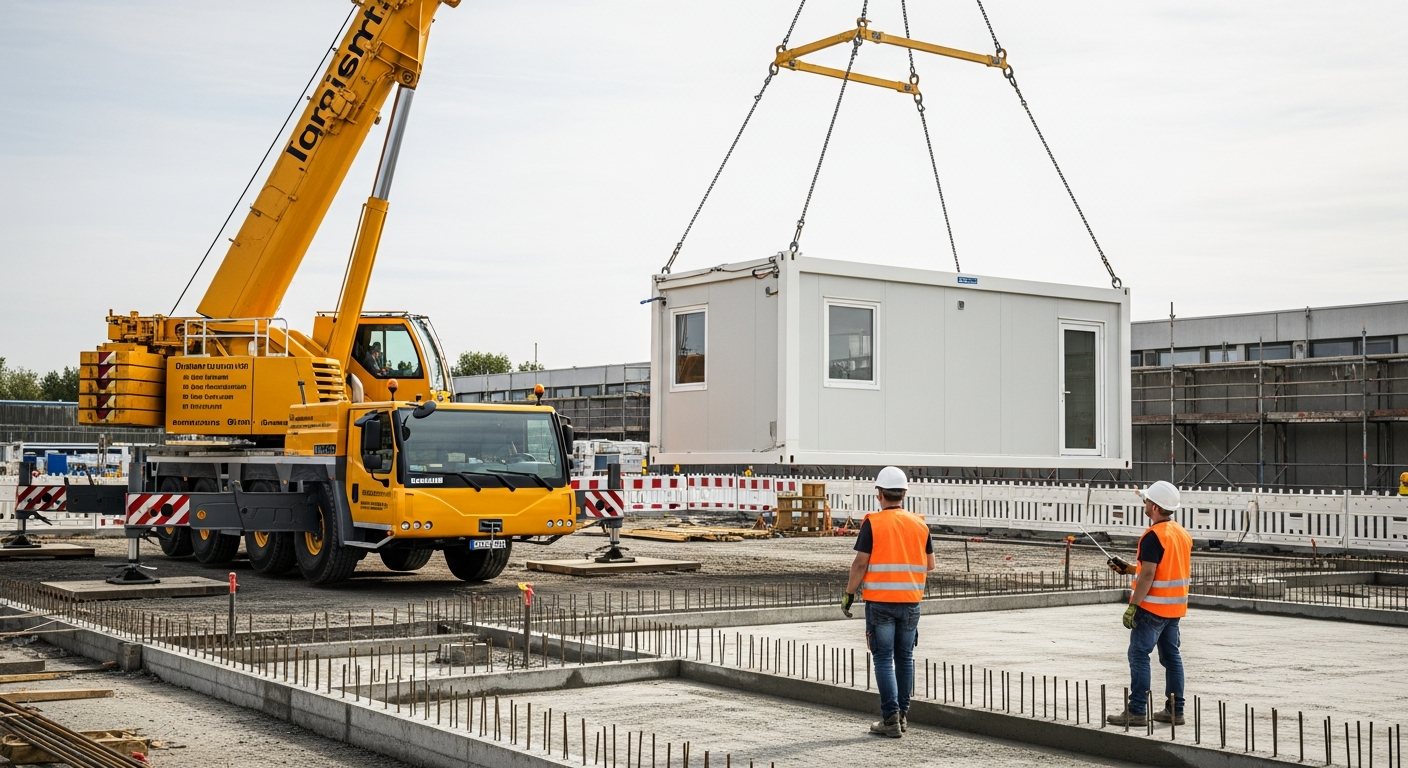
A standard LABtoGO typically weighs 8 to 10 tonnes fully equipped. Delivery is by standard low-loader lorry; installation is by mobile crane (size depending on container weight and outreach). On site it is set down on a load-bearing, level standing area – a slab or a founded, compacted gravel area. Bearing capacity and layer build-up must be demonstrated structurally for the project; point loads and lever moments feed into the design.
Services: 63 A CEE power connection (for the press, climate-controlled specimen curing, microscopes), water connection (for water bath, specimen curing, sanitary), waste-water connection or collection tank. On large construction projects with several successive phases – for example Deutsche Bahn tunnelling or motorway refurbishment over several sections – relocation during the hire period is often possible. The container can move with the construction phase.
Three configurations, three buyer groups
Contractors with their own batching plant or recycling plant
Permanent WPK station, standard concrete and geotechnical equipment. Hire-purchase 24–60 months, takeover at the end of the project or relocation to a follow-on site.
Testing engineers and accredited testing laboratories
Container in a 17025-/RAP-Stra-oriented, accreditation-ready configuration with documented climate control, equipment master data and a validation set-up. Actual suitability for ÜK-2/3 third-party supervision or RAP-Stra-15 testing bodies depends on the operator’s accreditation, scope of recognition, personnel and test area.
Environmental consultants and remediation planners
Focus on contaminant analysis (asbestos TRGS 519, PFAS pre-analysis, heavy-metal XRF, hydrocarbon screening). Airlock concept, dirty area, H-class vacuum as hardware standard.
What a Planexus site laboratory delivers
Planexus plans and supplies container laboratories in the German-speaking region and treats the construction site not as an obstacle but as a standard scenario. For site laboratories we have developed the following configuration building blocks:
- →Robust envelope in RAL 7016 anthracite with steel-sheet cladding – suitable for sites and vandalism.
- →Vibration-decoupled weighing table with its own concrete plinth for fresh-concrete density and geotechnical weighings at 1 mg precision.
- →Climate-controlled specimen curing to DIN EN 12390-2: under water or in a moist room at 20 ± 2 °C – measured and documented.
- →Airlock and dirty-area module for TRGS 519 asbestos sampling – including negative-pressure ventilation and H-class vacuum.
- →Relocatable to follow-on sites – including a hire-purchase model and logistical accompaniment from phase to phase.
- →Delivery from stock typically within 2 to 4 days, standard containers in 5 to 8 weeks, fully equipped instrument containers in 8 to 14 weeks from order, installation generally within one working day. Where siting is procedure-exempt under the LBO, the formal building-permit procedure falls away – we check the conditions for each location.
Your site laboratory in 8–14 weeks?
Describe your construction project – scale, phase, required tests (concrete/soil/contaminants) and location. We check procedure-exemption under the relevant LBO and propose the matching equipment configuration as well as siting and services.
Conclusion: from a logistics bottleneck to on-site routine
The developments of 2024–2026 – PFAS in REACH and the Drinking Water Directive, the Substitute Building Materials Ordinance, asbestos investigation of existing buildings and infrastructure acceleration – make the site laboratory a strategically sensible tool for many contractors, testing engineers and environmental consultants. Anyone with fresh-concrete testing, soil mechanics and contaminant pre-analysis on site can keep within the testing window of the DIN series, commission confirmatory analysis more selectively and respond faster to findings. In many federal states, siting as a procedure-exempt site facility is possible; lead time is typically 2 to 4 days where stock is available, 5 to 8 weeks for standard containers and typically 8 to 14 weeks for fully equipped instrument containers; relocation between construction phases is often provided for depending on the contract model.