Since early 2026, PFAS, the so-called forever chemicals, have stopped being a research topic and become routine. Every water supplier in Germany must comply with the new limit for the Sum of PFAS-20 and demonstrate compliance. That evidence comes from laboratories able to quantify individual substances reliably at around 1.5 nanograms per litre. According to the German accreditation body DAkkS, around 50 testing laboratories were accredited for this PFAS analysis under the Drinking Water Ordinance in January 2026.
This article is written for laboratory managers at water suppliers, environmental laboratories and public testing agencies who need more measurement capacity. It explains the legal requirements in Germany, Austria and Switzerland. It shows why a PFAS laboratory places different demands on rooms and building services than a conventional water lab. And it describes how a lab container meets those demands.

PFAS limits in drinking water: what applies since 2026
The 2023 Drinking Water Ordinance (TrinkwV) transposes the EU Drinking Water Directive (EU) 2020/2184 into German law. It introduces PFAS as a parameter in two stages. Both values are set out in Annex 2 of the TrinkwV:
| Parameter | Limit | Applies from | Substances |
|---|---|---|---|
| Sum of PFAS-20 | 0.1 µg/l (100 ng/l) | 12 January 2026 | 10 perfluorocarboxylic acids (PFBA to PFTrDA) and 10 perfluorosulfonic acids (PFBS to PFTrDS) |
| Sum of PFAS-4 | 0.02 µg/l (20 ng/l) | 12 January 2028 | PFOA, PFNA, PFHxS, PFOS |
Only substances that have been detected and quantified count towards the sums. Values below the limit of quantification are excluded. The concentrations of the individual substances must still be reported separately. That has a direct consequence for the laboratory: a higher limit of quantification produces lower reported sums. This is why the ordinance specifies how sensitive the measurement must be.
Method requirements under Annex 7
Annex 7 of the TrinkwV sets the performance characteristics. For PFAS this means:
- The limit of quantification must not exceed 30 per cent of the parametric value.
- For the sum parameters this is applied to the individual substances. Each must be quantifiable down to 1.5 ng/l, for both PFAS-20 and PFAS-4.
- The permitted measurement uncertainty (k = 2) is 50 per cent of the parametric value.
- The method must reliably measure concentrations at the parametric value with this uncertainty.
Only approved testing bodies may carry out the analysis. Under section 40 TrinkwV the federal states publish lists of these bodies and their parameter scope. According to DAkkS, the prerequisite is accreditation as a testing laboratory to DIN EN ISO/IEC 17025.
Key point
1.5 ng/l per substance means 1.5 billionths of a gram in one litre of water. At this level the quality of results is decided not only by the instrument but by the whole laboratory: materials, room climate, workflows and blank values.
Austria and Switzerland: status of PFAS rules
Austria added the parameter through an amendment to its Drinking Water Ordinance in February 2024. Since 12 January 2026 a parametric value of 0.10 µg/l for the sum of 20 PFAS applies there too. According to the state of Upper Austria, supplies delivering more than 100 m³ per day must include PFAS in their annual full analysis from 2026. Smaller supplies of 10 to 100 m³ per day have until 2032. An Austrian PFAS-4 stage for drinking water could not be confirmed at the time of writing.
In Switzerland, the TBDV ordinance currently regulates three PFAS individually: PFOS and PFHxS at 0.3 µg/l each, PFOA at 0.5 µg/l. On 27 May 2026 the Federal Council opened a consultation that proposes, among other things, a maximum of 0.1 µg/l for the sum of 20 PFAS. The consultation closed on 18 September 2026. No date of entry into force had been set at the time of writing. For laboratories in Switzerland this means measurement requirements are likely to move towards the EU level.
Why demand for PFAS laboratories is rising
Three developments coincide. First, PFAS is now a mandatory parameter for every water supplier, not just suspected cases. Second, PFAS-4 arrives in 2028 with a limit five times lower than PFAS-20. Suppliers with values close to that threshold will monitor more closely and track treatment measures with their own measurement series. Third, demand is growing beyond drinking water: groundwater, contaminated sites, soils, wastewater and food are all being tested for PFAS.
German broadcaster ZDF reported in early 2026 that an approved drinking water laboratory had been working at full stretch for months. Reliable nationwide figures on waiting times do not exist. One thing is clear, though: an additional LC-MS/MS system can be ordered, but a suitable room for it is often the bottleneck. Converting an existing laboratory while it keeps measuring samples is difficult. Options during a refurbishment are covered in our article on the temporary lab in rental containers.
How a PFAS lab differs from a conventional water lab
The methods are standardised. DIN 38407-42 (2011 edition) covers selected PFAS in drinking, ground and surface water as well as treated wastewater. Samples are enriched by solid-phase extraction (SPE) and measured by HPLC-MS/MS. DIN EN 17892:2024 deals specifically with PFAS in drinking water by LC-MS/MS and allows both direct injection and SPE.
The real challenge is stated in the standard itself: how low the limit of quantification actually is depends on the blank values a laboratory achieves. PFAS are present not only in the sample but also in the laboratory.
Typical PFAS sources in the laboratory
- LC system: PTFE solvent lines, degassers and pump parts can release PFAS. Instrument manufacturers recommend PEEK lines and polypropylene bottle caps.
- Delay column: a delay column between mixer and injector retains PFAS from the system. They then elute later than the PFAS from the sample and do not interfere with the evaluation.
- Vials and closures: PTFE-lined septa are unsuitable for PFAS analysis. Polypropylene or polyethylene vials and caps are the norm.
- Sample preparation: SPE cartridges, solvents and tubing must be checked for PFAS background. Long-chain PFAS also adsorb onto surfaces, causing losses.
- Room and fit-out: fluoropolymers are also found in seals, coatings and equipment. When planning a trace laboratory, every material in the working area should therefore be reviewed.
Carry-over adds to this. Calibration standards are far more concentrated than the samples. Preparing standards and samples at the same bench risks cross-contamination. Good practice is therefore to separate high-concentration and low-concentration work physically. That separation is easier to build into the floor plan than to enforce later through organisation.
Room schedule for a PFAS lab in a container
PFAS workflows are well established. They translate into a room schedule that maps neatly onto modules. How many modules a project needs depends on sample throughput and the number of instruments.
| Area | Function | Design focus |
|---|---|---|
| Sample reception | Receipt, registration, cold storage | Refrigeration capacity, short routes, LIMS connection |
| Sample preparation | SPE, evaporation under nitrogen, reconstitution in solvent | Fume cupboard, solvent handling, nitrogen supply |
| Standards preparation | Preparing calibration and internal standards | Separate from trace sample preparation |
| Instrument room | LC-MS/MS systems | Temperature stability, heat load, power, roughing-pump exhaust |
| Plant | Nitrogen generator, compressor, ultrapure water, UPS | Keep noise and heat out of the instrument room |
| Data evaluation | Data processing, release, reporting | Display-screen workstations, network, data backup |
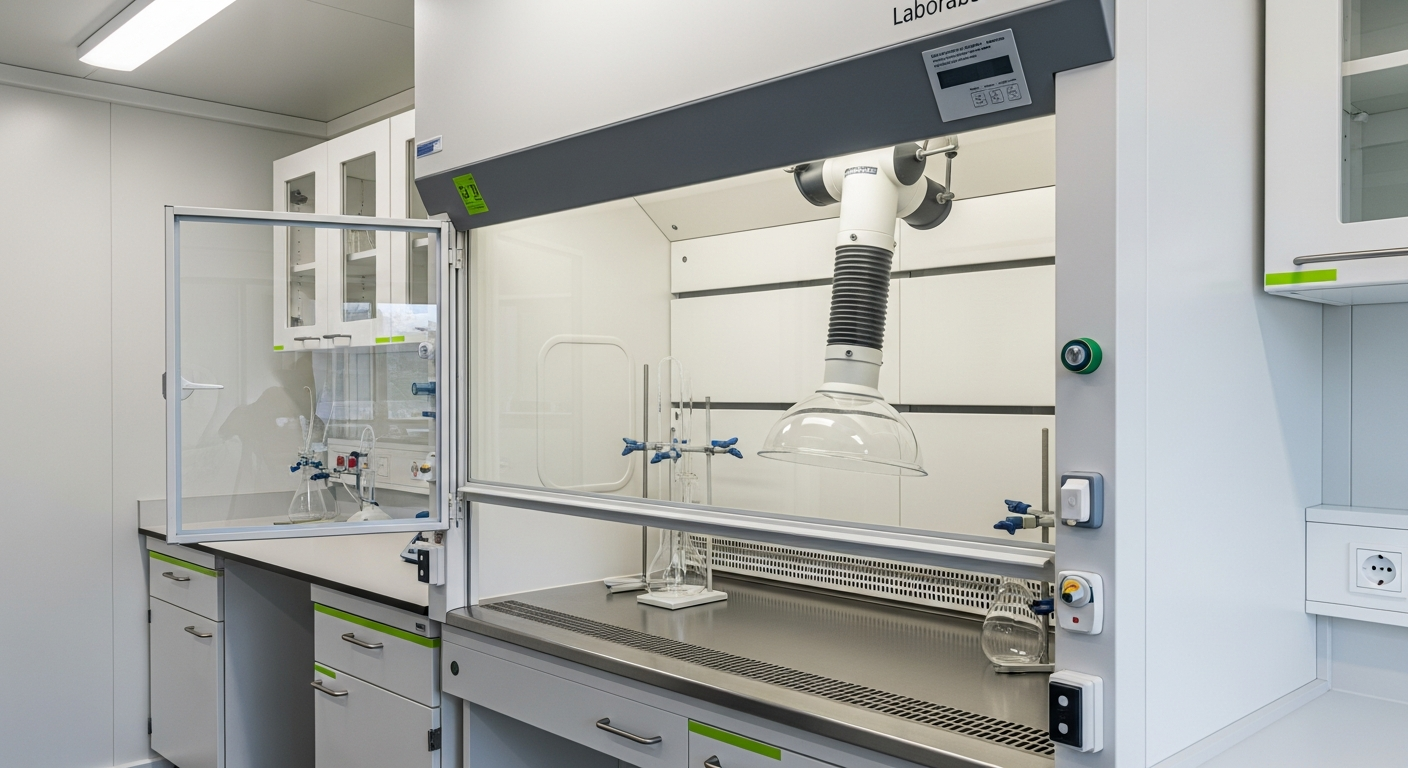
Evaporating extracts under nitrogen and handling methanol belong in a fume cupboard to DIN EN 14175. For fitting out the other areas, see our equipment checklist.
LC-MS/MS in a lab container: the technical requirements
Triple quadrupole mass spectrometers place clear demands on their location. Manufacturers summarise them in site preparation documents. The values below come from such documents for LC/MS triple quadrupole systems. They indicate the order of magnitude. The current document for your specific model always takes precedence.
| Requirement | Example values from manufacturer documents | Implementation in the container |
|---|---|---|
| Room temperature | Operation 15–35 °C, constant within ±3 °C of the calibration temperature | Cooling sized for instrument heat, insulated envelope, monitoring |
| Rate of change | Older LC/MS documents: no more than 2–3 °C per hour | Supply air routed so it does not blow directly onto instruments |
| Heat output | Below 4,500 BTU/h per system, roughly 1.3 kW. A nitrogen generator can add up to about 2.8 kW. | Cooling load calculated from the equipment list, generator ideally in a separate plant room |
| Nitrogen | Depending on model up to 30 or 50 l/min, 5.5–6.8 bar, hydrocarbon-free | Generator or liquid nitrogen, pipe routing, check need for oxygen-depletion alarm |
| Power | 200–240 V, dedicated outlets per system, voltage tolerance +10 / −5 %, noise-free earth | Dedicated circuits, UPS for measurement and data acquisition |
| Extract | Ion source and roughing-pump exhaust ducted outside | Connected local extract, included in the ventilation balance |
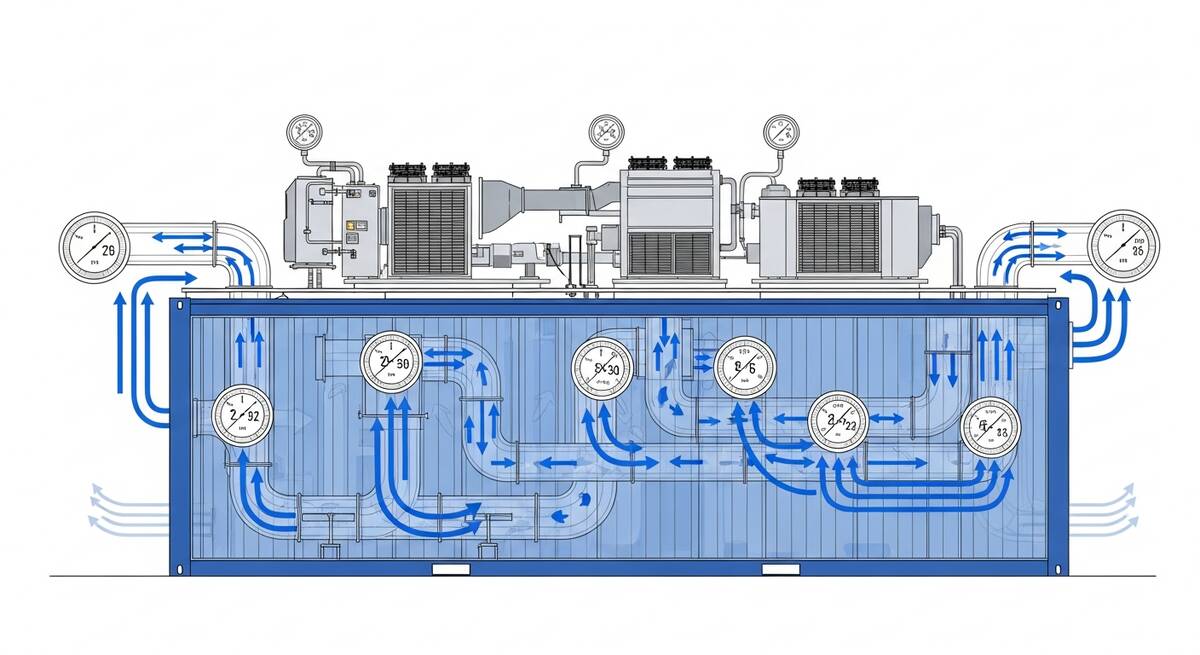
The most important factor in a container is the heat balance. Several instruments, HPLC pumps, computers and possibly a nitrogen generator share a small footprint, and summer outdoor temperatures add to the load. How we reconcile cooling load, air change rates and standards in a container is described in our article on HVAC in lab containers. Temperature, instrument status and nitrogen pressure can also be monitored remotely, as explained in the article on LIMS, IoT and remote monitoring.
Materials chosen at the factory
When converting an existing building you inherit the materials already there. With a lab container they are specified before construction starts. For a PFAS lab it is worth keeping a materials list for the working area as part of the specialist design: seals, tubing, furniture and surface coatings, fittings and the ultrapure water pipework. Where fluoropolymers are technically necessary, for instance for chemical resistance, that is a deliberate, documented decision.
Why a lab container makes sense for PFAS capacity
Time
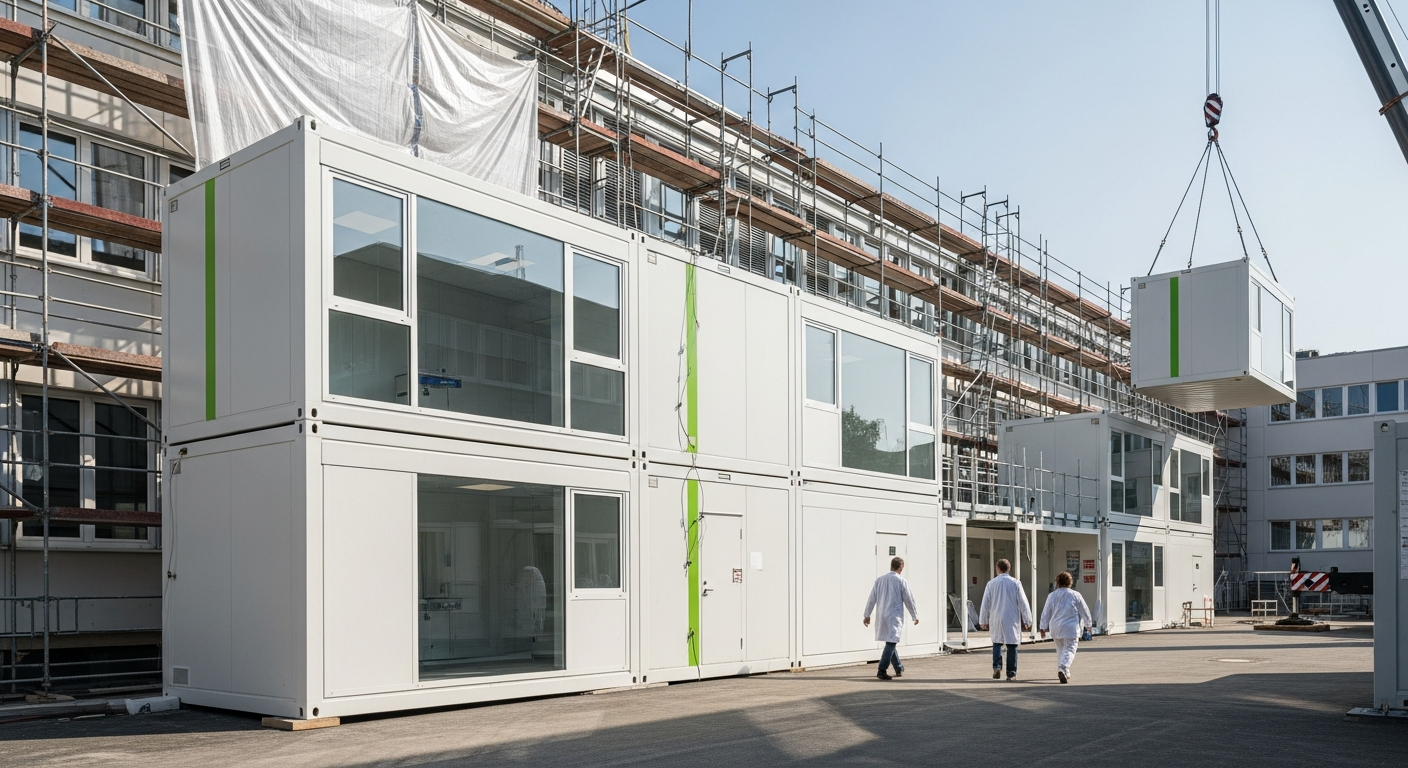
Factory manufacture typically takes 8 to 14 weeks, in parallel with permits and foundations. Ongoing laboratory work is not disrupted by a building site inside the premises.
Controlled environment
New envelope, new ventilation, specified materials. For a trace laboratory that is a better starting point than a converted older building.
Next to the existing lab
The container stands right beside the existing laboratory. Sample logistics, staff and LIMS remain shared.
For mobile deployments, such as measurement campaigns at waterworks or contaminated sites, a compact transportable system like the LABtoGO is a good fit. How mobile labs work on site is also shown in our article on materials testing on construction sites. If you plan laboratories for authorities and public testing agencies, see our page on public health and emergency preparedness.
Accreditation remains the laboratory's responsibility
A lab container provides the spatial and technical conditions. It does not confer accreditation. The laboratory must agree a new measurement room or site with its accreditation body and reflect it in its quality management system. That includes the room description, environmental monitoring, instrument qualification and method validation at the new location. Build this step into the programme from the outset. Clean technical documentation of the container makes it considerably easier.
Programme: counting back from 12 January 2028
If you want additional capacity ready for the PFAS-4 deadline, count backwards. The phases below are typical. Actual durations depend on permits, instrument lead times and the accreditation body.
- 1. Requirements and room schedule: sample volumes, number of instruments, equipment list with heat output and services.
- 2. Site and permits: location, foundation, service connections, planning law. Background in our articles on permits and installation and structural design.
- 3. Specialist design and procurement: ventilation, cooling, power, gases, materials list. What belongs in the documents is covered in the article on tendering with a requirements specification.
- 4. Factory manufacture: typically 8 to 14 weeks, with foundation and connections prepared on site in parallel.
- 5. Installation and commissioning: assembly, service connections, measurement of room conditions.
- 6. Instruments, validation, accreditation: LC-MS/MS installation, blank checks, method validation, coordination with the accreditation body.
Experience shows that delays rarely arise in the factory but from open questions at the start. The most common causes are described in our article on five planning mistakes. As of October 2026 that means: if you want to be measuring by early 2028, start step 1 now.
Checklist: planning a PFAS lab in a container
- → Estimate sample volumes today and after 2028
- → Choose the method: DIN 38407-42 or DIN EN 17892, direct injection or SPE
- → Obtain site preparation documents for the planned LC-MS/MS systems
- → Compile the heat load of all equipment, including the nitrogen generator
- → Provide separate areas for standards and trace samples
- → Keep a materials list for the working area with fluoropolymers in mind
- → Settle nitrogen, ultrapure water and power supply, including UPS
- → Plan environmental monitoring (temperature, humidity) with data logging
- → Inform the accreditation body early about the new measurement room
- → Decide between renting and buying based on the period of use
Conclusion
PFAS analysis of drinking water has been mandatory since 2026 and becomes more demanding in 2028. Measurements are made at 1.5 ng/l per substance. At that level, the quality of results depends on the whole laboratory: stable room climate, clean services, well-planned workflows and controlled materials.
A lab container can create these conditions faster than a conversion during ongoing operation. The prerequisite is a design that starts from the analytical methods rather than from square metres. Then an additional instrument becomes additional, accreditation-ready measurement capacity.
Plan your PFAS capacity
Do you need additional PFAS measurement capacity and want to know what a lab container has to deliver? Planexus works with you on room schedule, climate, services and materials and delivers the laboratory turnkey.
Request a free initial consultationSources: TrinkwV Annex 2, Annex 7 and section 40 (gesetze-im-internet.de); DAkkS announcement of 15 January 2026; AGES and the state of Upper Austria on the Austrian ordinance; FOEN and FSVO on the revision of the Swiss TBDV; DIN 38407-42, DIN EN 17892; site preparation documents from an LC/MS manufacturer. As of 8 October 2026.