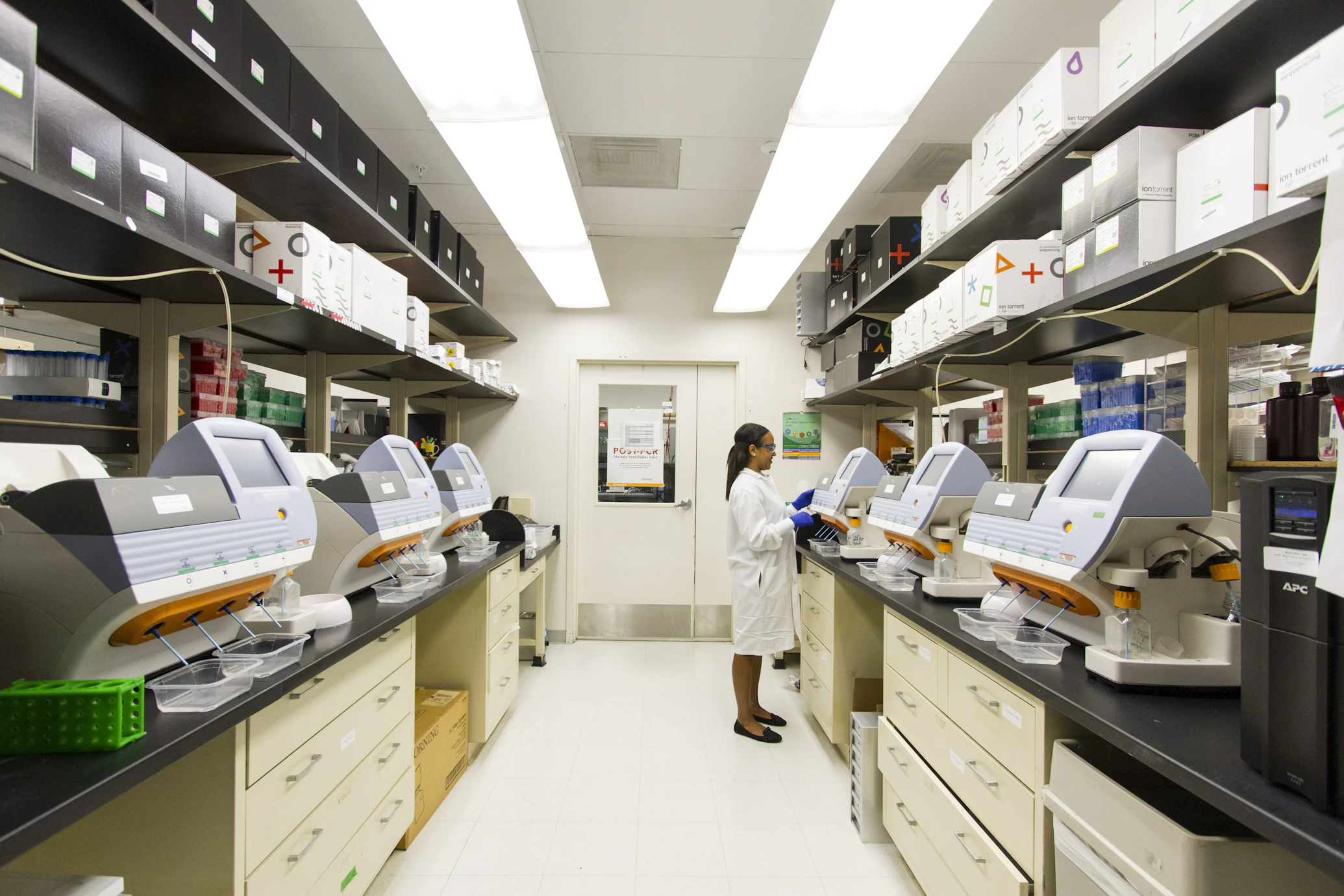
The energy transition is Germany’s largest industrial transformation since reunification. Three fields are driving demand for specialist laboratories particularly hard: green hydrogen (electrolysis, fuel cells, storage), battery-cell manufacture (research, misuse testing, recycling) and Power-to-X. All three share one thing: they work with flammable substances, high energy densities or both – and they need laboratories with explosion protection, gas detection and special fire protection that simply cannot be permitted in ordinary office buildings.
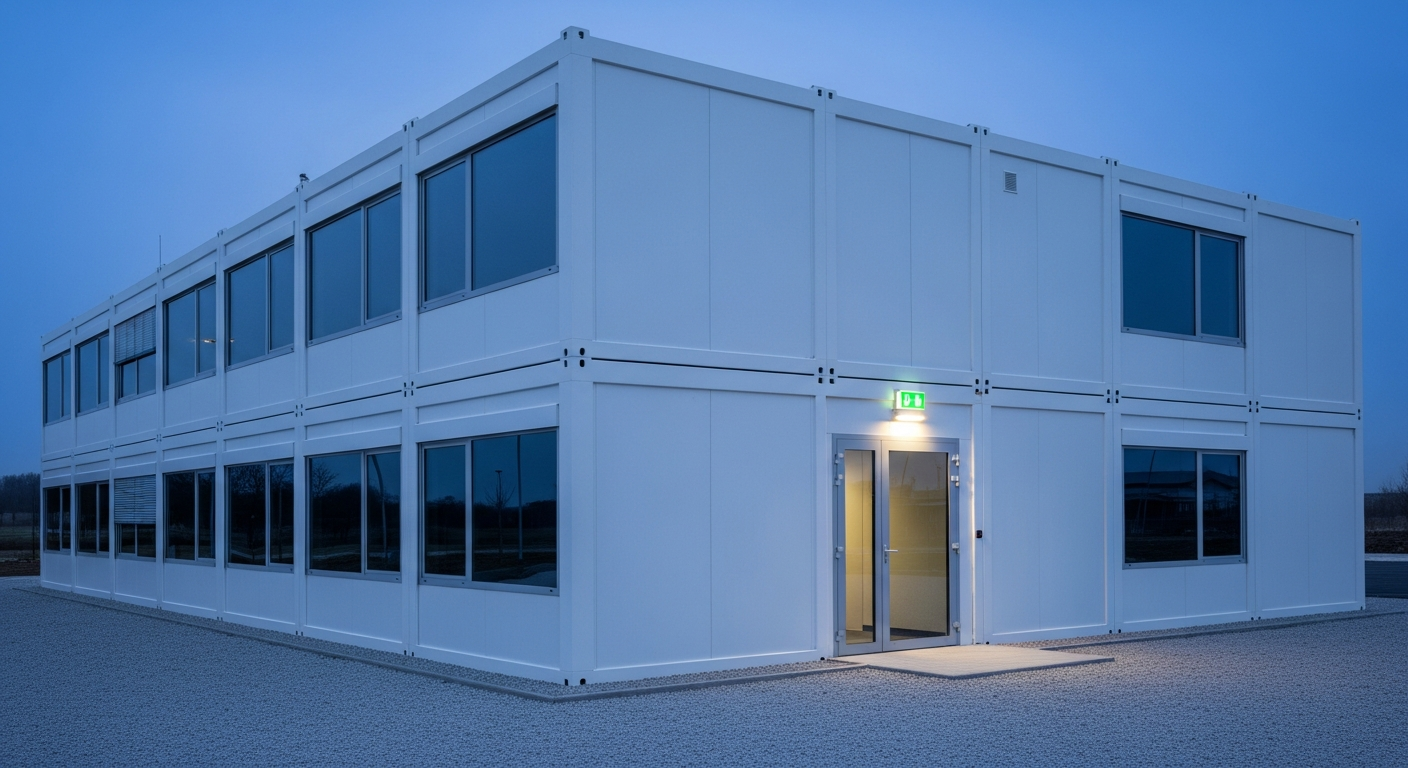
This is precisely where the modular laboratory container is the fastest solution. Instead of planning an extension to the existing building that takes two years and fails on the main building’s fire-protection concept, we place a free-standing container-laboratory block in the yard – with its own ATEX zoning, its own pressure relief, its own fire wall. In eight to fourteen weeks, turnkey.
Mega-trend energy transition: why demand is exploding now
The German government’s updated National Hydrogen Strategy (July 2023) raises domestic electrolysis capacity from 5 GW (2030, previous strategy) to 10 GW by 2030. In parallel the EU has approved state aid for the IPCEI hydrogen waves Hy2Tech, Hy2Use, Hy2Infra and Hy2Move – in Germany alone around EUR 5.4 billion flows from this into 28 Hy2Tech projects. Every one of these projects – from the membrane electrode assembly to a filling-station infrastructure component – needs a trial environment with an ATEX zone and hydrogen detection.
On the battery side, industrialisation is running in parallel: battery cell factories are emerging or already operating at several German sites – among them Schleswig-Holstein, Thuringia, Lower Saxony, Rhineland-Palatinate and Brandenburg. Every site needs an affiliated cell engineering lab – for incoming material qualification, misuse tests to IEC 62619 and thermal-runaway characterisation to UL 9540A. Exactly where we deliver container laboratories every day.
Then there are the research organisations: non-university research institutes, state research centres and university chairs of electrochemistry at several technical universities in Germany. All of them are expanding – and the existing buildings cannot provide it.
Observation from practice
In the past twelve months, every second enquiry at Planexus has come from the H₂ or battery environment. The typical trigger: a funding award is in place, the research team is ready – but there is no room in which work under ATEX conditions is permitted. We then deliver the container onto the works site, with a stand-alone Ex concept and integrated gas detection – operational before the building-permit application for the extension would even have been submitted.
Explosion protection in the container laboratory: ATEX 2014/34/EU and BetrSichV in practice
The legal framework consists of two pillars. The ATEX product directive 2014/34/EU governs equipment – every sensor, switch, fan motor and luminaire in the Ex zone must carry corresponding marking (e.g. “II 2 G Ex db IIC T4 Gb”). The ATEX workplace directive 1999/92/EC, implemented in Germany by BetrSichV § 6 and TRBS 2152 / TRGS 720–722, governs operation – who sets, documents and monitors which zone.
In a typical H₂ research container the picture is as follows:
- Zone 0: inside the experimental apparatus (e.g. inside a fuel-cell test stand or a compressed-gas cylinder). An explosive atmosphere is present continuously or for long periods.
- Zone 1: directly at vent lines, sampling points or welded joints from which hydrogen can occasionally escape in normal operation.
- Zone 2: the entire experimental room, provided tight apparatus is used. An explosive atmosphere occurs only in the event of a fault or maintenance, briefly and rarely.
- Ex-free: measurement and evaluation room with office computers, laboratory PCs and standard control technology – separated from the experimental room by an airlock and overpressure.
This spatial separation is architecturally easy to implement in a container laboratory: we divide the module with a fire-resistant internal wall (REI 90) and a personnel airlock with two self-closing doors. Control cabinets go in the Ex-free area or are pressurised to EN 60079-2. Cabling is routed ATEX-compliant through sandwich penetrations. We write the explosion protection document with you – not from the textbook, but from lived project practice.
Gas detection: seeing hydrogen before it becomes dangerous
Hydrogen is a physically demanding guest: at a density of 0.0899 kg/m³ it is around 14× lighter than air, its flammability range lies between 4 and 77 vol% in air, and the minimum ignition energy is only 0.019 mJ – equivalent to the electrostatic charge on a plastic chair. The consequence: detection must run continuously, in the right place and with calibrated sensors.
Three sensor principles are in use: catalytic pellistors (classic, robust, service life around 3–5 years), semiconductor sensors (inexpensive, cross-sensitive) and MEMS thermal-conductivity sensors (modern, less cross-sensitivity, good for high H₂ concentrations). For research laboratories we recommend the catalytic variant in the lower measuring range (0–100 % LEL) plus a thermal-conductivity sensor for concentrations above that – if an unplanned release occurs, the control system knows exactly how much hydrogen is in the room.
The switching thresholds are standard: pre-alarm at 20 % LEL (equivalent to 0.8 vol% H₂ in air, visual + audible, increased ventilation), main alarm at 50 % LEL (2 vol% H₂, automatic shutdown of the experimental plant, emergency ventilation, no access). Devices are used certified to EN 60079-29-1. Sensors are mounted near the ceiling, at least one per 25 m² of floor area, plus a sensor directly above each test stand. Connection to the building management system (or a dedicated Modbus interface) makes the container a monitored safety area – even when nobody is on site.
Ventilation in the H₂ container: when eight air changes are not enough
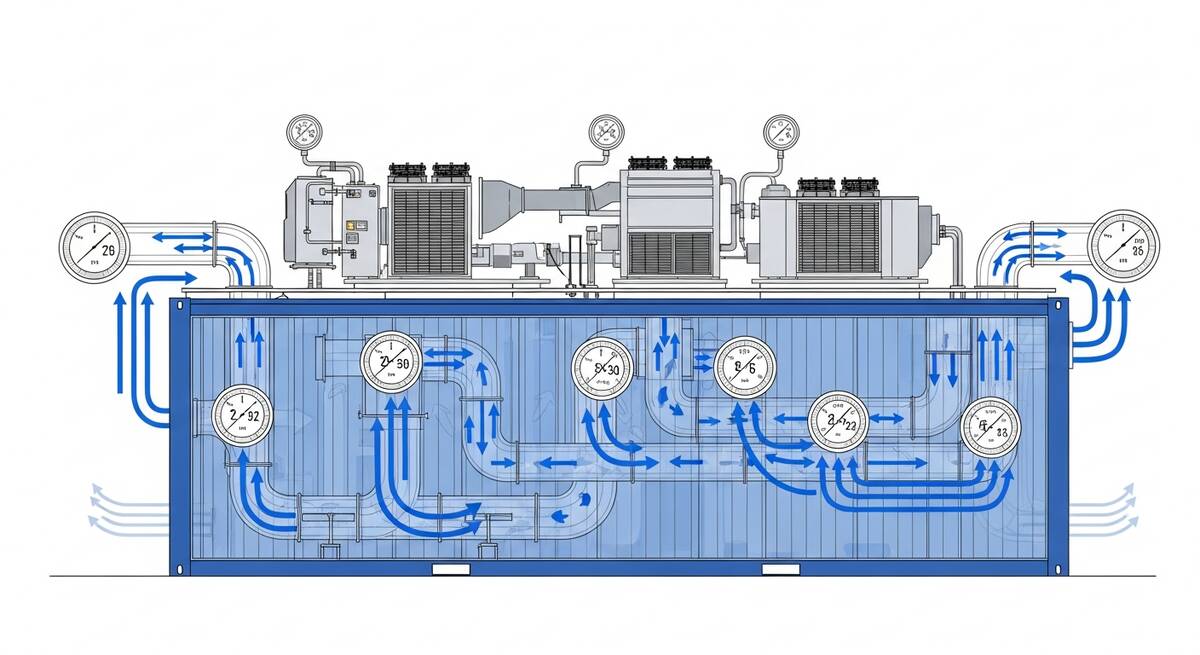
DGUV Information 213-053 “Safe working in hydrogen laboratories” sets the guideline value: at least eight air changes per hour in standard ventilation. For trials with an elevated release risk this is raised to 15 to 25 h⁻¹. In a main-alarm case, emergency ventilation starts and flushes the entire module within a few minutes.
Three points are decisive here, and they distinguish us from standard HVAC planning:
- Extract at the highest point: because H₂ rises, extraction must be flush with the ceiling. We fit roof cowls with weather louvres, never wall outlets.
- Explosion-protected fans: theoretically an ignitable atmosphere can pass through the extract stream – so fans to EN 14986 in Ex execution, with spark protection and an ATEX motor.
- Pressure cascade: experimental room at a slight negative pressure (–10 to –20 Pa) relative to the measurement and evaluation room; the latter at a slight positive pressure relative to outside air. In an emergency, air therefore flows from the clean area into the contaminated area – never the reverse.
Heat recovery is achieved – unlike in a normal laboratory – not via plate heat exchangers with direct air contact, but via separate circuits (run-around coil systems) or heat pipes, so that no H₂ can enter the supply-air path. We publish the air-balance calculation in the explosion protection document – that is mandatory, and it is also the point at which poor planning offices often fail.
Battery testing in the container: thermal runaway, misuse, recycling
Different standards apply to lithium-ion and solid-state batteries, but the spatial requirements resemble the H₂ laboratory. The most important test categories:
Misuse tests to IEC 62619 / 62620
Overcharge, deep discharge, short circuit, nail test, crush test, external fire. Energy release per cell up to 100 kJ. Requirement: enclosed test volume, pressure relief, automatic fire fighting.
Thermal runaway to UL 9540A
Characterisation of vent-gas composition, pressure history, cell-to-cell propagation. Standard for stationary storage in the USA, increasingly also required in EU permits.
Climatic tests / lifetime
Climatic chambers –40 °C to +85 °C (material qualification up to +180 °C), cycle life to UN 38.3, IEC 62660 for automotive. Normal operation, no explosion protection needed – but a thermal-runaway reserve.
Recycling / dismantling
Manual opening of aged modules – fire- and gas-risk. Inerted glovebox, CO/HF detection, locally extracted workbench. Growing demand here from EU Battery Regulation 2023/1542.
A misuse container typically consists of three zones: test chamber (with pressure relief in the form of a bursting panel in the ceiling, water-mist sprinklers or aerosol fire fighting), observation room (with high-speed cameras, thermography, pressure recording – electrically cleanly separated) and preparation room (charge/condition equipment, sample handling). HVAC is designed for 10–15 air changes, with activated-carbon filtration of the extract if fluorine-containing vent gases arise (HF, POF₃ – characteristic of LiPF₆ electrolytes).
The advantage of the container is particularly clear here: an explosive bursting panel in the roof of a stand-alone module is permittable. On the third floor of a research building it simply is not.
Fire protection: more than a sprinkler
An H₂ or battery container has its own fire-protection concept, prepared by an approved expert. The most important building blocks:
- Structure: steel frame construction with fire-protection coating, internal lining F90 / REI 90 to DIN EN 13501.
- Early fire detection: VdS-approved smoke detectors plus heat detectors – for battery tests supplemented by off-gas detection (CO, H₂, VOC), which detects a thermal runaway 10–15 minutes before the first visible smoke.
- Extinguishing technology: for H₂ no water extinguishing in the Ex zone (follow-on reaction possible), instead inerting with nitrogen or argon. For battery tests water mist with additive or aerosol generators (FK-5-1-12), which briefly reduce the oxygen supply.
- Fire compartments: container spatially separated from the main building, minimum distance 5–10 m depending on the fire-protection concept.
- Pressure relief: bursting panels in wall or roof, designed for the maximum internal overpressure of the experimental apparatus (typically 100–500 mbar actuation pressure).
Funding landscape 2026: what can be drawn down?
The funding landscape for energy-transition research is denser in 2026 than ever – but also more confusing. Here are the most important programmes that come into question for research institutes, automotive suppliers and start-ups:
IPCEI Hy2Tech, Hy2Use, Hy2Infra, Hy2Move
Important Projects of Common European Interest. State-aid approval by the European Commission, implemented in Germany by BMWK. Funding of large-scale R&D along the hydrogen value chain. In Hy2Tech alone, 28 German projects with around EUR 5.4 billion of federal and state funds.
Target group: industrial consortia with cross-border impact.
BMBF flagship projects H2Giga, H2Mare, TransHyDE
H2Giga: series manufacture of electrolysers. H2Mare: offshore hydrogen. TransHyDE: transport infrastructure. Around EUR 740 million in total for the first funding phase, an extension is planned.
Target group: research consortia of universities, non-university research institutes and industry.
BMWK “Research and development in electromobility”
Call for battery-cell manufacture, recycling, charging infrastructure. Funding rate 25–50 % for industry, up to 80 % for SMEs in basic research. Applications via the competent project management agency.
Target group: automotive suppliers, battery manufacturers, recyclers.
KfW 295 – Climate Protection Offensive for companies
Interest-subsidised loan for climate-protection investments, including R&D infrastructure. Up to EUR 25 million per project, repayment grant up to 30 %.
Target group: SMEs and mid-caps with a concrete climate-protection effect.
ZIM – Central Innovation Programme for SMEs
Theme-open R&D funding for SMEs. Funding rate up to 45 % depending on company size and region. Fast, lean application procedure.
Target group: mid-sized component and plant manufacturers.
EXIST research transfer
Funding of university spin-outs with a research need. Up to EUR 250,000 of equipment over 18 months for the preparation phase. Second phase combinable with venture capital.
Target group: scientists from universities founding an H₂ or battery start-up.
Practical tip: container laboratories are classifiable as eligible investment in almost all funding programmes – both on purchase (capitalised asset, straight-line depreciation over 10–15 years) and on hire (ongoing equipment cost). The 8- to 14-week lead time fits almost every project timetable, where conventional construction overshoots the funding period by months.
Three target groups, three container concepts
1. Research institutes & universities
Need: modular trial environment for changing third-party-funded projects, often 1–3 years’ duration. Requirement: rapid set-up, rapid dismantling, reusability. Solution: container laboratory for hire or hire-purchase, with a framework Ex concept and interchangeable experimental modules.
2. Automotive suppliers & OEMs
Need: permanent expansion of the cell engineering lab or fuel-cell development at the main site. Requirement: industrial availability, GMP to ISO 14644 classes for cleanroom work, connection to SAP / works LIMS. Solution: turnkey container with complete qualification (IQ/OQ/PQ), 24/7 service.
3. Start-ups & spin-offs
Need: first own laboratory after EXIST or seed financing. Requirement: low initial investment, no long-term lease in the incubator. Solution: hire container with option to buy, sited in a technology park or on the university campus.
What an H₂ or battery container from Planexus brings
- ✔ Explosion protection document to BetrSichV §6 with zone plan, sensor layout, shutdown concept
- ✔ ATEX-certified equipment from the switchgear cabinet to the emergency lighting
- ✔ H₂ detection to EN 60079-29-1 with pre-alarm/main alarm and control
- ✔ Ventilation 8–25 h⁻¹, redundant, with heat recovery via separate circuits
- ✔ Pressure-relief area in wall or roof, designed to VDI 2263
- ✔ Fire-protection concept with expert stamp, off-gas detection for batteries
- ✔ Conductive floor coverings (ESD), earthing of every conductive component
- ✔ FAT at the Albstadt works before delivery, IQ/OQ/PQ at the installation site
- ✔ Documentation to the EU Machinery Directive and CE declaration of conformity for the complete module
A typical project – say a fuel-cell test stand for an automotive supplier in Stuttgart or a battery-misuse container for a research institute in Munich – starts with a two-hour requirements workshop. Six weeks later the explosion protection document is ready for approval; a further eight to ten weeks later the module stands operational on the works site.
The energy transition does not wait for building-permit applications. Anyone investing in H₂ or battery research in 2026 has no time for a two-year permitting loop. The modular laboratory container is the fastest, standards-compliant and fundable answer.
Your H₂ or battery laboratory in 8–14 weeks?
Our engineers have in the past twelve months realised containers for fuel-cell test stands, electrolysis research and misuse tests. Tell us what you are planning – we reply with a concrete concept including an Ex-concept sketch.
Request a free initial consultation