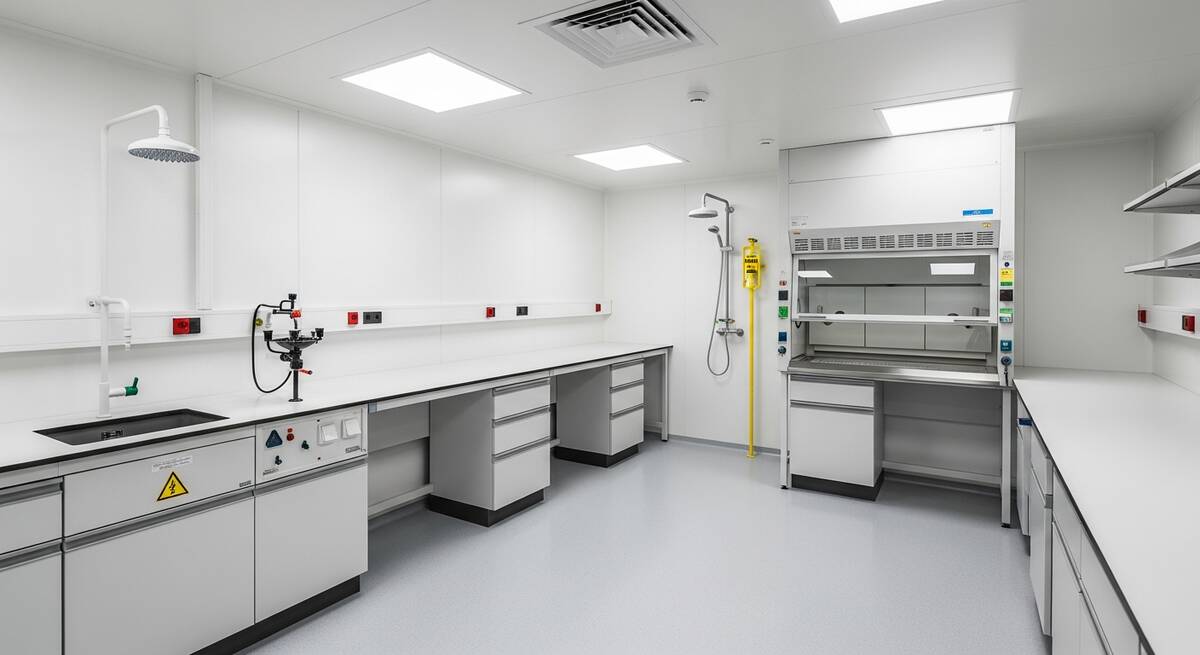
A laboratory fire rarely starts dramatically. A knocked-over beaker of acetone, an overheated heating mantle, a short circuit in a drying oven, a defective battery in a charger – and within seconds a fire load burns that an ordinary office never sees. In the lab container everything stands closer together, which makes it worse. That is exactly why fire protection in the lab container is not an appendix to the design, but its foundation.
Fire protection consists of three pillars that interlock: structural fire protection (fire resistance of elements, non-combustible construction products, fire compartments), active fire protection (detectors, extinguishing agents, emergency lighting, ventilation) and organisational fire protection (means of escape, signage, instruction, hazardous-substance storage). This article walks through all three – with the standards that actually apply in the German-speaking countries, and with the clear dividing line where we as container builders end and the fire-safety expert, building control and the operator begin.
Fact table: the fire-protection standards in the lab container
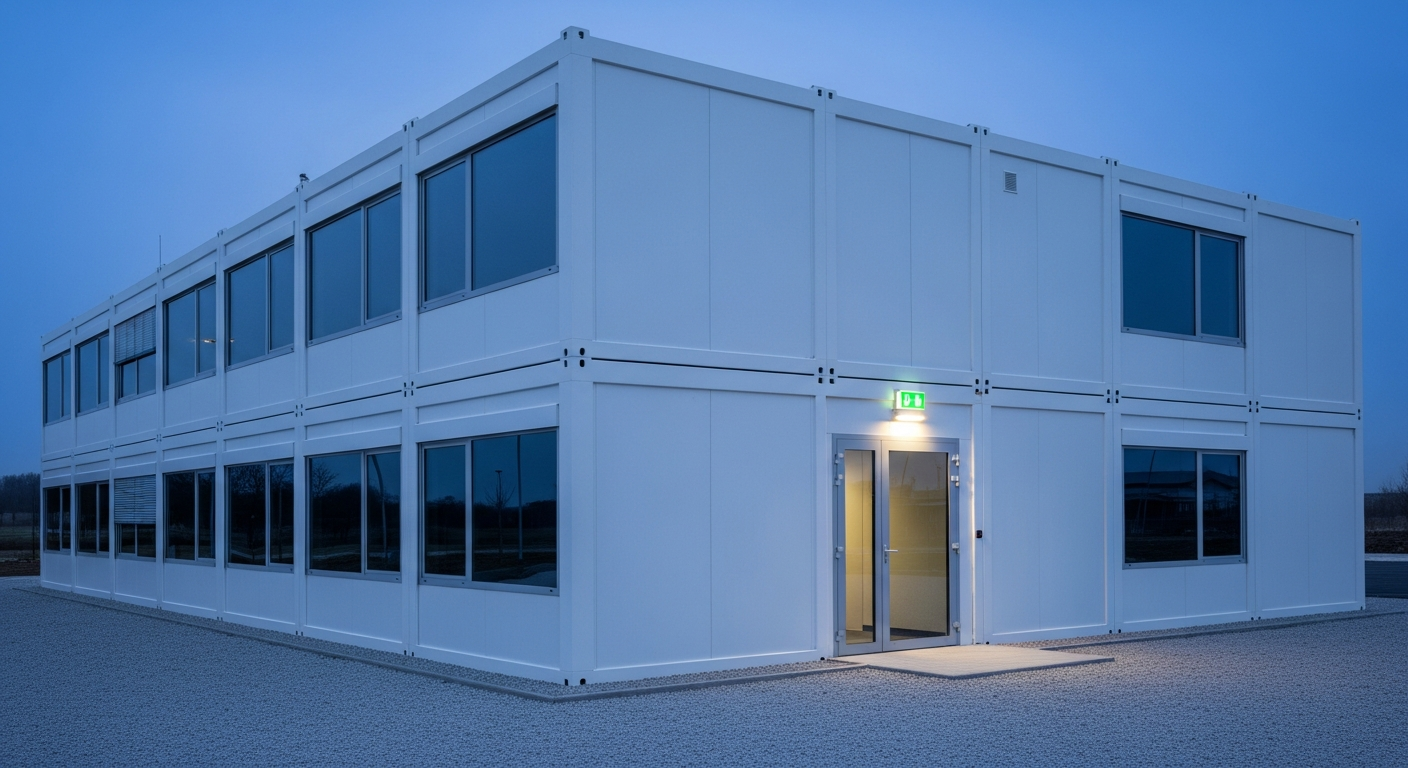
Fire protection in the lab container works within a framework of building-control law, fire-protection standards, hazardous-substances law and workplace rules. The following overview is required reading for every fire-safety concept.
| Area | Standard / requirement | What it governs |
|---|---|---|
| Building-control law | Model Building Code (MBO) / state building codes | Fire-protection requirements by building class, special building laboratory |
| Fire resistance of elements (national) | DIN 4102-2 | Fire-resistance classes F30 / F60 / F90 / F120 |
| Fire resistance of elements (European) | DIN EN 13501-2 | Classification R / E / I (e.g. EI 90, REI 90) |
| Reaction to fire, products (national) | DIN 4102-1 | Construction-product classes A (non-combustible) and B (combustible) |
| Reaction to fire, products (European) | DIN EN 13501-1 | Euroclasses A1–F, smoke s1–s3, flaming droplets d0–d2 |
| Safety cabinets, flammable liquids | DIN EN 14470-1 | Fire-protected cabinets Type 15 / 30 / 60 / 90 |
| Safety cabinets, compressed-gas cylinders | DIN EN 14470-2 | Fire-protected storage of compressed-gas cylinders |
| Hazardous-substance storage | TRGS 510 (edition since 16 February 2021) | Storage in portable containers, segregation, ventilation |
| Laboratory operation (hazardous substances) | TRGS 526 | Safe working in laboratories, fire protection (Section 4.8) |
| Laboratory operation (occupational safety) | DGUV Information 213-850 (May 2020) | Fundamentals of laboratory safety, fire protection and means of escape (Ch. 6.2) |
| Fire-extinguishing equipment | ASR A2.2 | Measures against fires, extinguishing units, fire classes A–F |
| Escape and rescue routes | ASR A2.3 (new edition 2022, amended 11/2024) | Minimum widths, travel distances, doors, emergency lighting |
| Fire detection and alarm systems | DIN 14675 + DIN VDE 0833-1/-2 | Design, operation and fire-service peripherals of FDAS |
| Safety signage | ASR A1.3 (DIN EN ISO 7010) | Rescue, fire-protection and warning signs |
| Emergency / safety lighting | ASR A3.4/3 + DIN EN 1838 | Emergency lighting and illuminated rescue signs |
Structural fire protection: fire resistance and construction-product classes
Structural fire protection answers two questions: how long does an element withstand fire? And how much does the construction product itself contribute to the fire? The first question is answered by the fire-resistance class, the second by the construction-product class. Both are governed in Germany by two parallel standard systems: nationally in DIN 4102 and at European level in DIN EN 13501. DIN 4102 remains the familiar workhorse in construction practice; the European classification is the more precise and, in the CE context, the governing one.
The fire-resistance class to DIN 4102-2 is given with the letter F and the endurance in minutes: F30, F60, F90, F120. An F90 element withstands the standardised fire curve for at least 90 minutes. DIN EN 13501-2 breaks this blanket statement into individual performance criteria – R for load-bearing capacity, E for integrity (no passage of flames and hot gases) and I for insulation (limited temperature on the unexposed face). A non-load-bearing partition with 90 minutes of protection is called EI 90 there; a load-bearing and integrity-providing wall is REI 90. F90 and EI 90 describe the same protection objective – the European class simply states more precisely which function is maintained.
The construction-product class to DIN 4102-1 divides roughly into Class A (non-combustible) and Class B (combustible). Class A subdivides into A1 (without combustible constituents) and A2 (practically non-combustible), Class B into B1 (limited combustibility), B2 (normally ignitable) and B3 (easily ignitable). European DIN EN 13501-1 uses the Euroclasses A1, A2, B, C, D, E and F and supplements them with two additional criteria that decide life and death in a real fire: smoke production (s1 = very low to s3 = high) and flaming droplets (d0 = no droplets to d2 = heavy dripping). In a closed lab container, smoke production is especially critical because it can make escape impossible within seconds.
The sandwich-panel core decides: mineral wool instead of foam
A lab container is fabricated in sandwich construction: two steel facings, an insulation core between them. Exactly this core is the point at which structural fire protection stands or falls – and the point at which the market most often cuts corners, because the core is invisible from outside. The reaction to fire of the three common core materials differs fundamentally:
| Core material | Class (DIN EN 13501-1) | Reaction to fire |
|---|---|---|
| Mineral wool | A1 / A2 (in combination with steel) | Non-combustible, no contribution to fire load, no smoke gases |
| PIR (polyisocyanurate) | B-s1,d0 to B-s2,d0 | Combustible, limited combustibility, low to medium smoke gases |
| PUR (polyurethane) | E to F | Combustible, normally to easily ignitable, heavy smoke production |
For a temporary office-container scheme a PUR or PIR core may suffice. In a lab container with elevated fire load from solvents, gases and electrics, a non-combustible mineral-wool core (A1/A2) is the only choice that is clean in fire-protection terms. Mineral wool contributes nothing to the fire load, does not melt into flaming droplets and produces no toxic smoke gases. It is also the prerequisite for walls to reach higher fire-resistance classes at all. We deliver our lab containers with mineral-wool panels and document the classification – so that the fire-safety expert has a robust basis in the building application rather than a promise.
From practice: what I watch for as a trained fire officer
Before the Planexus years I served with the professional fire service. What you learn there: in an emergency, minutes count, and most people do not die from the flame but from the smoke. That is why for me the smoke class (s-criterion) is at least as important as the fire-resistance class. A wall build-up that holds for 90 minutes but produces heavy smoke in a fire protects the building and not the people. In the lab container we therefore raise both: a non-combustible core and low smoke production, plus a second escape route that remains reachable even if the main entrance is smoke-logged. — Thomas Boss
Fire compartments and fire-resisting separations in a modular assembly
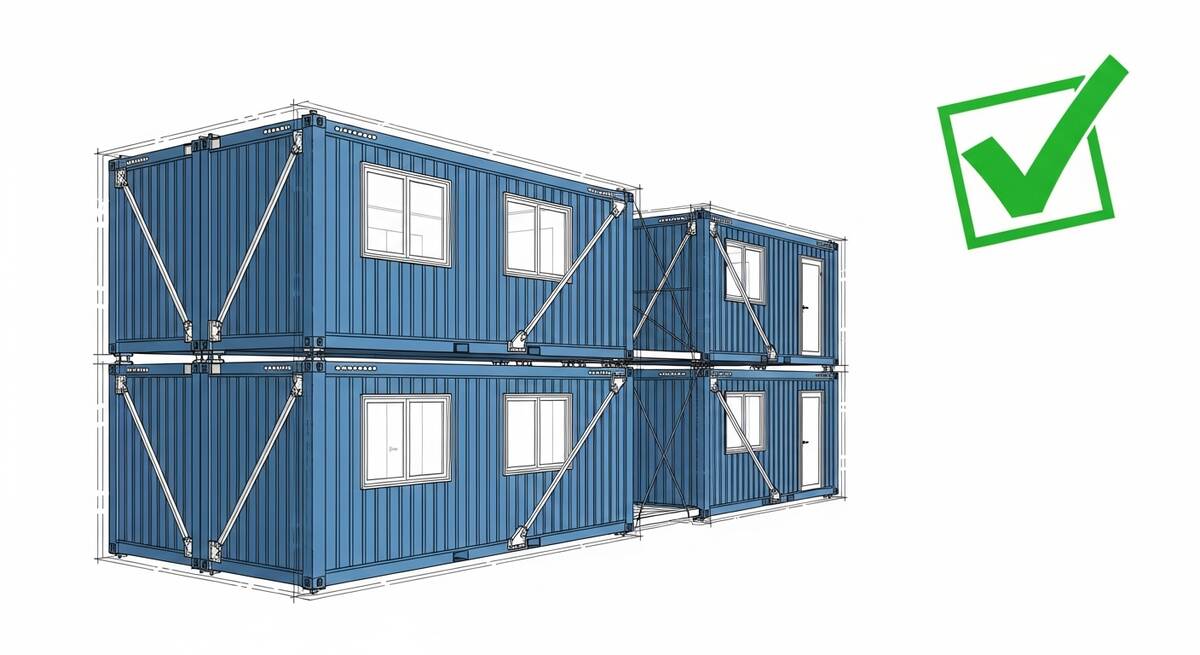
As long as a single lab container is operated free-standing and single-storey, the fire-protection situation is manageable. As soon as modules are stacked, joined into larger units or connected to an existing building, the question of fire compartments comes into play. In building-control terms, fire compartments are meant to prevent a fire spreading unhindered through the entire structure. The separating elements between compartments must then achieve a defined fire-resistance class – typically F30 to F90, or EI 30 to EI 90, depending on building class and concept.
In the lab container this concerns not only the wall itself, but every penetration: ventilation ducts, services, cable trays and doors. An F90 wall is worthless if the ventilation duct runs through it unsealed. That is why fire-resisting separations need fire dampers in the ducts, tested penetrations seals (cable and pipe collars) and fire doors of the matching class (e.g. T30/T90 to DIN 4102-5 or EI₂ 30-C/EI₂ 90-C to DIN EN 13501-2). These components must be coordinated with one another and documented in the fire-safety concept. We plan the penetrations so that every opening through a fire wall is closed with a tested system – no hole without evidence.
Hazardous-substance storage: TRGS 510 and the Type 90 safety cabinet
The largest avoidable fire load in the laboratory is the hazardous substances themselves – above all flammable solvents. Their storage is governed by TRGS 510 “Storage of hazardous substances in portable containers” (edition since 16 February 2021). It specifies the Hazardous Substances Ordinance and describes the recognised state of the art: anyone who complies with it can assume fulfilment of the legal duties (presumption of conformity). TRGS 510 governs quantity thresholds, segregation prohibitions, technical ventilation, spill trays and the requirements on storage equipment.
The central component is the fire-protected safety cabinet to DIN EN 14470-1. The standard knows four types, named after their fire-resistance duration: Type 15, Type 30, Type 60 and Type 90. The common Type 90 guarantees that the cabinet interior in the standardised fire test does not heat by more than 180 kelvin for 90 minutes. That keeps the contents well below the auto-ignition temperature of common solvents – the 90 minutes are the time in which people can escape and the fire service can intervene. Compressed-gas cylinders are stored analogously in cabinets to DIN EN 14470-2. Lithium-ion batteries, which represent a growing fire load in energy research, belong in storage and charging cabinets designed for that purpose.
In the lab container we plan the positions for safety cabinets from the outset: load-bearing substrate, connection to the cabinet’s technical extract, adequate circulation and escape-route width in front. A Type 90 cabinet “put somewhere” after the fact, whose extract is not connected and which narrows an escape route, only half fulfils its purpose.
Active fire protection: detect, extinguish, see
Active fire protection ensures that a fire is detected early, fought quickly and the escape route remains visible. Three components belong in every seriously used lab container:
Fire detection. For many standard lab containers, standards-compliant smoke alarms suffice. Where the fire-safety concept or the building permit requires more – higher building class, special building, unattended night operation, high fire load – an automatic fire detection and alarm system (FDAS) to DIN 14675 in conjunction with DIN VDE 0833-1/-2 becomes necessary, possibly with connection to the fire service including fire-service control panel and indication tableau.
Extinguishing agents. Type and number of extinguishers follow ASR A2.2 and the fire hazard. Extinguishers are assigned to fire classes: A (solid, glowing substances), B (liquid substances such as solvents and oils), C (gases), D (metal fires, for example alkali metals) and F (cooking fats and oils). In the laboratory fire class B is almost always relevant; with reactive metals, D with special metal-fire powder is added. CO₂ extinguishers are popular because they extinguish electrical equipment without residue. The required number of extinguishing units is calculated from floor area and hazard.
Visibility in an emergency. Emergency lighting to ASR A3.4/3 and DIN EN 1838, and illuminated rescue signs to ASR A1.3 (DIN EN ISO 7010), ensure that the escape route remains recognisable even in a power failure and smoke-logging. In a window-poor lab container that is not a comfort, but vital.
Organisational fire protection and means of escape
The best construction technology is useless without a functioning escape route. What governs are ASR A2.3 “Escape and rescue routes” (new edition March 2022, last amended November 2024) and Chapter 6.2 of DGUV Information 213-850 “Safe working in laboratories”. The principle: in laboratories, rescue routes and exits must be present in sufficient number, depending on the substances and working methods used. Where the hazard is elevated, a second, independent escape route is required – in the container therefore not only the main entrance, but a second door or an emergency exit.
Concrete constructional requirements are added: clear minimum widths and heights of circulation and escape routes, doors that open in the direction of escape and can be opened without special tools, and limited travel distances to the next place of safety. Organisationally, escape and rescue plans, regular fire-protection instruction and – depending on the operation – evacuation drills complete the picture. TRGS 526 “Laboratories” further specifies fire-protection duties in ongoing laboratory operation in Section 4.8. We consider door openings, emergency exits and signage already in the layout, matched to the planned occupancy and laboratory size.
Fire protection by application: BSL, GMP, ATEX
Fire protection is not a uniform package – it scales with the application. In a BSL-2/BSL-3 container laboratory, fire protection collides with containment: a door that must open in a fire must not override the biological safety level – that is solved via airlocks, defined pressure stages and coordinated emergency concepts. In the GMP and cleanroom container, fire dampers and penetration seals must be compatible with cleanroom qualification. And in laboratories for hydrogen and battery research, fire protection joins explosion protection to ATEX – here the focus shifts from “prevent fire” to “prevent an ignitable atmosphere”.
These interactions are the reason fire protection must not be an afterthought. It belongs in the first planning phase, together with the permitting path. How the entire route from idea to handover runs is shown in our article on the project process; the legal side is covered in more depth in the article on permits and building law.
Conclusion: fire protection is design, not equipment
Fire protection in the lab container does not arise from a few extinguishers on the wall. It arises from the interplay of a non-combustible wall build-up, coordinated fire compartments, standards-compliant hazardous-substance storage, early fire detection, visible means of escape and a clear organisational concept. Every pillar has been treated as dispensable at some point – and that is exactly where the dangerous gaps arise.
Because our lab containers leave the Albstadt factory with mineral-wool panels, documented classifications and prepared connections for safety cabinets and fire-protection plant, the fire-safety concept can be set up cleanly from the start. Our planning and engineering service covers coordination with the fire-safety expert and building control – from a single source, with a clear chain of responsibility.
Design the fire-safety concept in from the start?
We plan wall build-up, fire compartments, hazardous-substance storage and means of escape together with the expert and building control – with verified standards and without gaps.
Request a free initial consultation