Climate change presents every industry with new challenges — laboratory construction included. Laboratories are among the most energy-intensive building types of all. High air-change rates, precise climate control and the operation of numerous instruments lead to energy consumption that is often ten times that of a normal office building. It is all the more important to put sustainability at the centre of laboratory planning and realisation.
The challenge: laboratories’ appetite for energy
An average laboratory consumes between 300 and 500 kWh of energy per square metre per year — conventional office buildings manage with 50 to 100 kWh. The reasons for this enormous energy demand are many: ventilation plant must move large volumes of air to extract pollutants. Air-conditioning systems hold temperature and humidity within tight limits. Laboratory instruments such as refrigerators, centrifuges or analysers often run around the clock.
Modular laboratory construction offers particular opportunities here: through controlled manufacture and the use of the latest technologies, Planexus lab containers can achieve energy consumption well below the industry average — without compromising functionality.
Sustainable materials
Solar integration
Recyclable
Energy recovery
The thermal envelope: insulation at the highest level
The first line of defence against energy losses is the building’s thermal envelope. Modern Planexus lab containers set new standards here. The wall elements consist of highly insulating sandwich panels with an insulation thickness of 80 to 120 millimetres. The core of rigid polyurethane foam or mineral wool achieves thermal transmittance coefficients (U-values) of under 0.20 W/m²K.
For comparison: the current German Buildings Energy Act (GEG) requires a U-value of no more than 0.24 W/m²K for external walls. Our containers undershoot this value significantly and reach Passivhaus level. This leads to considerable savings in heating and cooling — depending on location and use, between 30 and 50 per cent compared with standard solutions.
Expert tip: avoid thermal bridges
Particular attention is paid to connection points. In technical planning we optimise every detail junction to minimise thermal bridges. This applies in particular to windows, doors and penetrations for media.
Windows and glazing
For glazing, too, we specify the highest quality. Triple-glazed window elements with low-emissivity coating and noble-gas filling achieve U-values of under 0.8 W/m²K. Where use allows, specialist solar-control glass is used, reducing solar gain in summer without substantially impairing natural daylight.
Intelligent climate technology
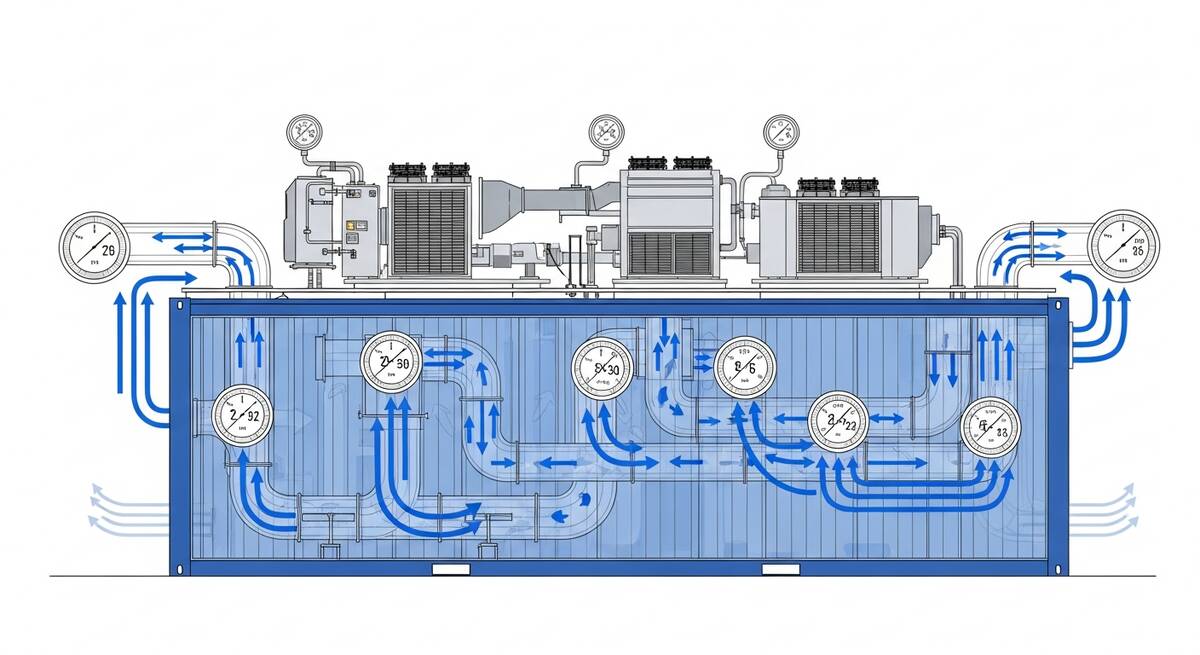
Climate control is traditionally the largest energy consumer in the laboratory. Modern ventilation and climate systems, however, offer numerous opportunities to increase efficiency. The heart is heat recovery: high-efficiency plate heat exchangers or rotary heat exchangers transfer up to 85 per cent of the heat from the extract air to the supply air.
Precise control
Room-by-room temperature control with ±0.5°C accuracy
Heat recovery
Up to 85% energy recovery from extract air
Humidity management
Adiabatic cooling reduces cooling energy demand
Free cooling
Use of cool outdoor air for climate control
Variable air volumes
Conventional laboratory ventilation often operates with constant air volumes — regardless of whether the laboratory is fully occupied or empty. Modern VAV systems (Variable Air Volume) adjust the air volume dynamically to actual demand. Sensors capture air quality and occupancy; the ventilation plant responds accordingly.
For fume cupboards that are used only intermittently, VAV systems can reduce extract performance when the sash is closed. This saves considerable quantities of conditioned air — and thus energy. Savings can amount to 20 to 40 per cent depending on the usage profile.
Important: safety comes first
When implementing energy-saving measures, safety must never be compromised. Our consulting experts ensure that all measures comply with the applicable safety regulations.
LED lighting and daylight use
Lighting typically accounts for 15 to 20 per cent of total energy consumption in laboratories. Switching from conventional fluorescent tubes to LED technology reduces this share by 50 to 70 per cent. Modern LED systems also offer advantages in light quality: they are dimmable, flicker-free and can be adjusted in colour temperature.
Artificial lighting is complemented by optimised use of daylight. Generous window openings, light-directing louvres and daylight-dependent controls ensure that natural light is used as well as possible. Studies show that good daylight not only saves energy but also increases staff productivity and wellbeing.
Sustainable material selection
Sustainability begins with the choice of materials. At Planexus we pay attention to short transport routes, recyclable materials and the avoidance of problematic substances. The steel construction of our containers is more than 90 per cent recyclable — and itself consists to a considerable extent of recycled steel.
Our material criteria:
- Preference for recyclable and recycled materials
- Avoidance of halogenated plastics (PVC) where possible
- Low-emission interior materials to the AgBB scheme
- Wood products from sustainable forestry (FSC/PEFC)
- Regional procurement to minimise transport distances
- Durable materials for maximum service life
Laboratory-grade surfaces from sustainable sources
The interior surfaces of lab containers must meet high requirements: chemically resistant, easy to clean, abrasion-resistant. At the same time they should be as sustainable as possible. Our laboratory equipment therefore also includes worktops from recycled material and coatings without concerning solvents.
Renewable energy and self-supply
The roofs of lab containers are excellently suited to the installation of photovoltaic systems. Depending on size and orientation, 30 to 50 per cent of electricity demand can be covered by solar energy. Under particularly favourable conditions and moderate consumption, complete self-supply is even possible.
For sites with a good wind resource, small wind turbines can be a useful complement. Combined with battery storage, these systems enable largely autonomous energy supply — ideal for remote research stations or field laboratories without a grid connection.
Expert tip: use funding programmes
Attractive funding programmes from the German federal government and the states are available for energy-efficient laboratory buildings and renewable energy. As part of our consulting services we support you in identifying and applying for suitable funding.
Smart building and energy management
Networking all technical systems enables intelligent energy management. Our Smart Lab solutions continuously capture the energy consumption of all systems and instruments. Algorithms identify savings potential and optimise operation automatically.
The results are impressive: through intelligent load management, demand-based control and avoidance of peak loads, a further 10 to 20 per cent of energy can be saved — on top of the savings from efficient hardware. At the same time, transparency improves: on clear dashboards you can see at any time where energy is consumed and where optimisation potential exists.
Life-cycle assessment and circular economy
True sustainability shows itself not only in operation, but over the entire life cycle. Modular lab containers have a decisive advantage here: they are designed for dismantling and reuse. At the end of use at one site they can continue to operate elsewhere, be converted or — if no longer needed — be broken down into their components and recycled.
This flexibility reduces resource consumption considerably. While conventional laboratory buildings often have to be demolished after 30 to 50 years, lab containers can remain in use far longer through modernisation and conversion. The initial investment is thus used over a longer period — good for economics and for the environment.
Conclusion: sustainability as a competitive advantage
Sustainable laboratory construction is not a contradiction of functionality and economy — on the contrary. Energy-efficient lab containers lower operating costs, improve the working climate and strengthen the image of a responsible organisation. With Planexus you choose a partner that understands sustainability not as a trend, but as a founding principle.
Request sustainability consultingAbout the author
Thomas Boss
Technical Director