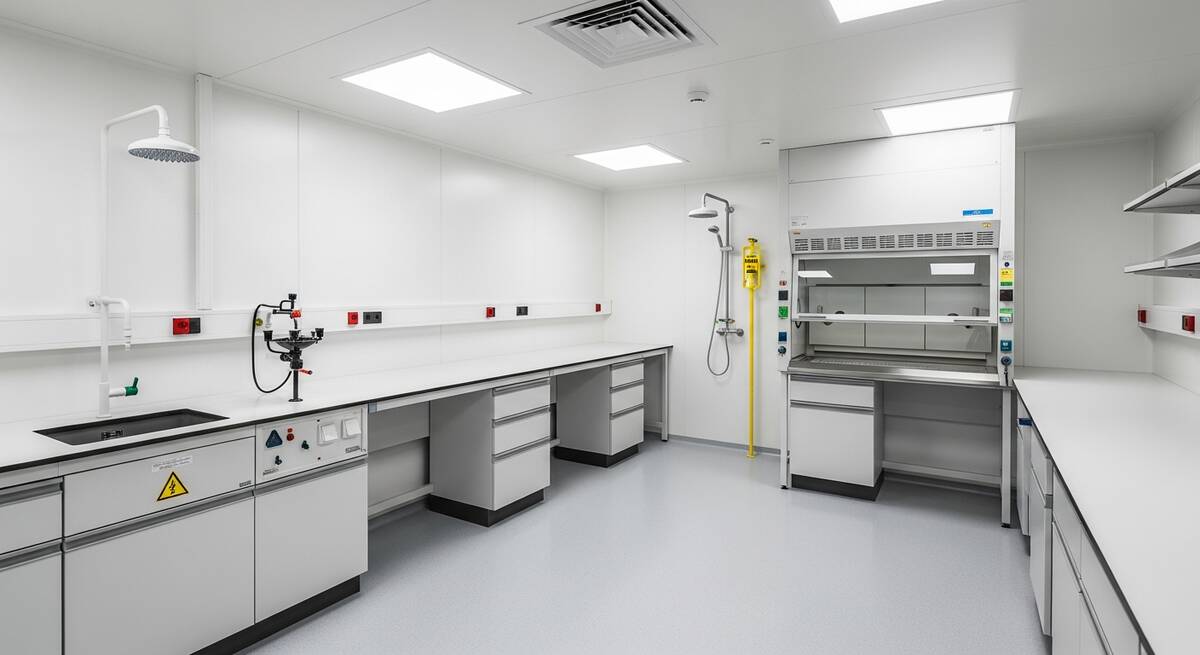
Few components decide so directly over the health of laboratory staff as the fume cupboard. It captures vapours, gases and aerosols exactly where they arise and extracts them in a controlled way before they reach the breathing zone. At the same time it is the hungriest consumer in the laboratory and the point at which the entire ventilation design stands or falls. In the lab container, where plant space is scarce and every cubic metre of extract air is expensive, a poorly planned cupboard forgives no errors.
This article sets the subject out from first principles: how a cupboard protects at all, what DIN EN 14175 regulates in its seven parts – and what it deliberately no longer prescribes –, which cupboard types exist, how the enormous energy consumption can be reduced with VAV technology, and how extract routing in the container is solved cleanly to DIN 1946-7. Plus the clear dividing line: we deliver the cupboard ready for use, complete with ventilation plant – the risk assessment and the recurring test remain operator duties.
Fact table: the standards of fume-cupboard engineering
Fume cupboards sit in a framework of product standard, hazardous-substances law, occupational safety and room-air technology. The following overview is required reading for every cupboard and ventilation design in the laboratory.
| Area | Standard / requirement | What it governs |
|---|---|---|
| Product standard, fume cupboards | DIN EN 14175 (Parts 1–7) | Terms, safety, type and on-site testing, VAV, special types |
| Legacy cupboards (pre-2003) | DIN 12924-1 / 12924-2 | General-purpose and fume cupboards to the old status, face velocity ≥ 0.7 m/s |
| Laboratory operation (hazardous substances) | TRGS 526 “Laboratories” | Safe working, cupboard use, test duties (Section 7.3) |
| Laboratory operation (occupational safety) | DGUV Information 213-850 | Regulatory part substantively identical to TRGS 526, with practical notes |
| Hazardous-substances law (overarching) | GefStoffV | Effectiveness check of technical protective measures at least every 3 years |
| Room-air technology, laboratory | DIN 1946-7 | HVAC design, min. 25 m³/h per m² of laboratory area, negative-pressure holding |
| Tracer-gas type test | DIN EN 14175-3 (SF₆) | Containment: inner/outer plane + robustness test |
| VAV fume cupboards | DIN EN 14175-6 | Variable air volume, annual test of the control loop |
How a fume cupboard protects: the operating principle
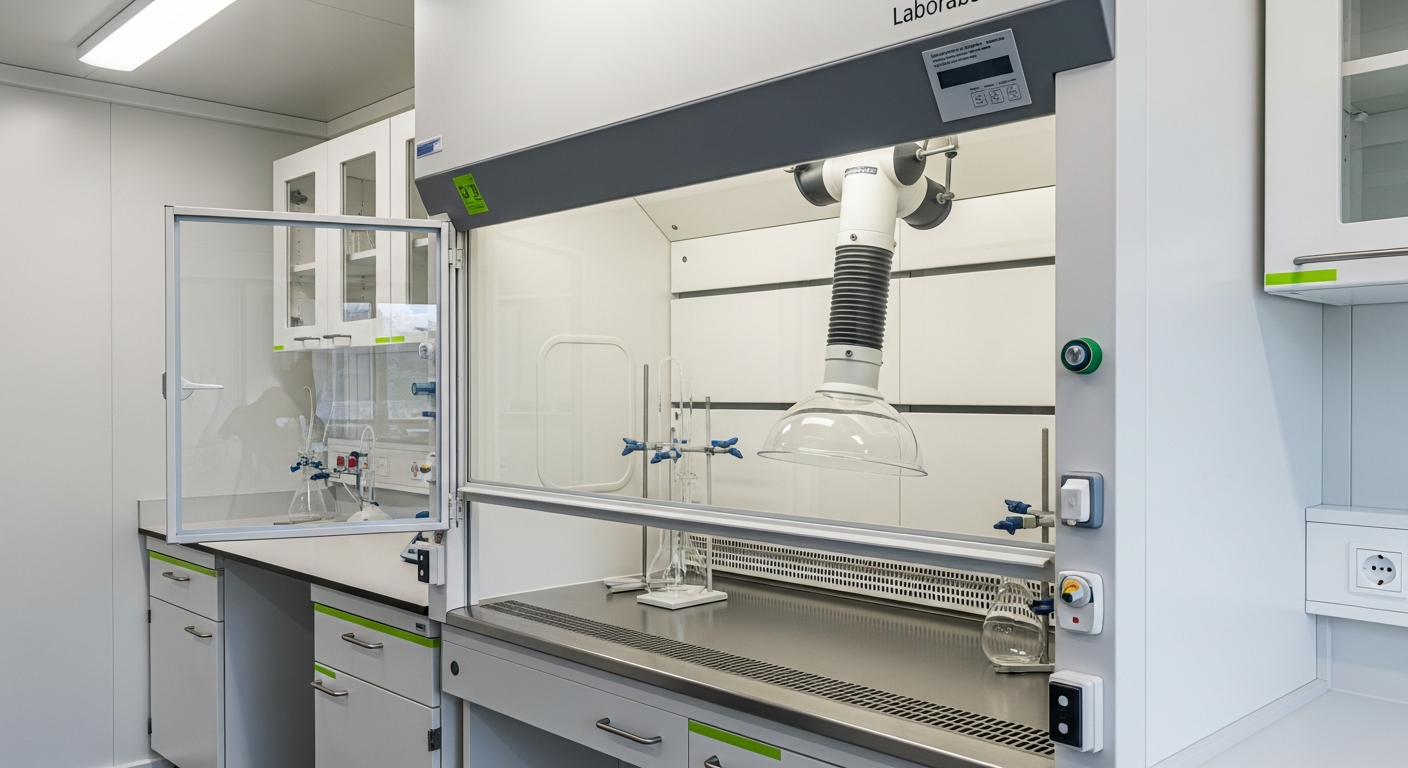
A fume cupboard – also known in the specialist literature as a digestorium – is a semi-enclosed working chamber with a movable sash (the vertically travelling glazed panel). The protective principle is simple and ingenious at once: room air flows in a controlled way through the front opening into the chamber and forms an air barrier. This incoming air takes with it the vapours, gases and aerosols released inside, carries them rearwards and upwards to the extract spigot and discharges them through the duct. As long as the airflow is correct and the sash is held low, nothing reaches the breathing zone of the person standing in front.
That is why the protective effect hangs on two quantities that must not be confused: containment (can the cupboard keep the substances inside?) and face velocity or extract volume flow (how much air flows in and is extracted?). When working with volatile, toxic or flammable substances, a standards-compliant cupboard is not optional but required. And it only works if the make-up air in the room is actually available – a cupboard is only ever as good as the ventilation plant behind it.
DIN EN 14175: the seven parts and what they govern
The DIN EN 14175 “Fume cupboards” series is the European basis for the design, qualification and operation of laboratory fume cupboards. It replaced the former national DIN 12924-1 and is organised in seven parts that build on one another:
| Part | Title | Subject |
|---|---|---|
| Part 1 | Terms | Uniform terminology for manufacturers, designers and operators |
| Part 2 | Safety & performance | Minimum constructional requirements, max. working opening 0.5 m, limiter |
| Part 3 | Type test methods | Type test in the laboratory with SF₆ tracer gas, containment, robustness test |
| Part 4 | On-site test methods | Commissioning (Ch. 5) and repeat testing (Ch. 6) at the operator |
| Part 5 | Installation & use | Recommendations on installation, use and safe operation |
| Part 6 | VAV fume cupboards | Variable air volume depending on sash position |
| Part 7 | Special types | Non-conventional cupboards (e.g. with supply-air introduction), own test criteria |
The decisive paradigm shift relative to the old DIN 12924: DIN EN 14175 contains no blanket guide values for containment or extract volume flow. Instead it provides a test-based system – from type test through on-site test to recurring inspection. The extract volume flow needed for the specific application is set by the operator under their own responsibility as part of the risk assessment. That shifts responsibility – and makes clean design from the outset even more important.
Containment and the SF₆ type test to Part 3
Containment is the core quantity of cupboard safety: the ability to keep airborne substances inside the working chamber. It is determined in the type test to DIN EN 14175-3 in a special test room – with the tracer gas sulphur hexafluoride (SF₆). The gas is non-toxic and therefore ideal for measurement, but strongly climate-damaging: its global warming potential is around 30,000 times that of CO₂. Part 3 comprises three tests:
Inner plane. Containment is measured directly at the working opening – does tracer gas leave through the front plane? Outer plane. Measurement slightly in front of the cupboard shows what actually reaches the room. Robustness test. This is the most demanding test: in addition to tracer-gas release, a standardised plate (1900 × 400 × 20 mm) moves past the cupboard at 1 m/s and simulates a person walking briskly by. This checks whether the cupboard holds its tightness even when the airflow is disturbed from outside. A well-designed cupboard shows practically zero on the inner and outer planes – only the robustness test separates the wheat from the chaff.
From practice: where cupboards fail in real operation
A cupboard can shine in the test laboratory and still fail in operation – not because of the unit, but because of the surroundings. The two most common causes I see on site: first, missing make-up air. If supply air cannot keep up because the room is too tight or the ventilation was undersized, face velocity collapses, however good the cupboard. Second, the open sash: the higher it is raised, the worse containment and robustness become – and in continuous operation energy consumption rises massively. That is why in the container we always design supply-air compensation and extract capacity together with the cupboard, rather than merely “connecting” the cupboard. — Thomas Boss
Face velocity: 0.7 m/s, 0.5 m – and why they are not the same thing
This is where most misunderstandings arise. On legacy cupboards to DIN 12924 (January 1978 edition) a clear minimum applied: the mean face velocity with the sash open 100 mm must be at least 0.7 m/s. A measured value of only 0.5 m/s is below that – the cupboard may then not continue in use for work with hazardous substances until the cause (blocked filters, weakening fan, excessive back-pressure, leakage) is rectified. Measurement is made with a thermal or vane anemometer.
On modern cupboards to DIN EN 14175 this blanket velocity value no longer exists – what matters is the containment demonstrated in the type test; the setpoint for volume flow comes from the risk assessment and the test report. And now the classic: the much-quoted 0.5 m from the standard refers to the maximum sash opening height (an – often alarmed – limiter to Part 2), not to the face velocity. 0.7 m/s is a velocity, 0.5 m is a height – confuse the two and you design wrongly.
Cupboard types: from bench-mounted to perchloric-acid cupboard
There is no such thing as “the fume cupboard” – the type follows substances, apparatus and working method. The most important types:
| Type | Feature | Typical use |
|---|---|---|
| Bench-mounted (standing) cupboard | Work surface ~900 mm; widths 1,200 / 1,500 / 1,800 mm; ~270–400 m³/h per lin. m | Standard for solvents, dilute acids and alkalis |
| Low-level cupboard | Lowered work surface (~500 mm), more internal height | Tall apparatus, distillation set-ups, exhaust lines |
| Walk-in cupboard | Work surface at floor level, depth up to ~1,500 mm | Large-volume plant, pilot set-ups, distillation columns |
| Pass-through cupboard | Operable from both sides, sashes on two faces | Workstations at which work is done from two sides |
| Hydrofluoric-acid cupboard (HF) | HF-resistant lining (e.g. PP), corrosion-proof | Work with hydrofluoric acid and strongly aggressive media |
| Perchloric-acid cupboard | Washable, with rinse system against explosive perchlorate deposits | Digestions with perchloric acid |
| Radionuclide cupboard | Decontaminable, filter stages, radiation-protection compliant | Work with unsealed radioactive substances |
In the container laboratory the type choice is tightly bound to the layout: a walk-in cupboard needs height and places high demands on extract capacity; a perchloric-acid cupboard needs rinse-water infrastructure. We select type, grid size and number to suit the available extract capacity and the installation – so that the cupboard does not become the bottleneck of the entire ventilation system.
Energy: why a cupboard uses a small power station – and how VAV helps
Fume cupboards are the largest energy consumers in the laboratory. A single cupboard can use up to 3.5 times the energy of an average detached house – not through the unit itself, but through the air: supply and extract fans run continuously, and the incoming outdoor air must be conditioned (heated or cooled) without interruption. Studies, including from Harvard University, show the scale: laboratory floor area occupies about one fifth of the building area but consumes around half the energy – some 44 % of that falls to ventilation, driven largely by the cupboards.
The most effective technical lever is the VAV cupboard (Variable Air Volume) to DIN EN 14175-6. Unlike the constantly running CAV cupboard, it modulates extract volume flow according to sash position: when the sash is lowered, volume flow falls. With the sash closed, volume flow can be reduced by about 50 %; compared with a CAV system, energy savings of up to 40 % are possible – with a markedly lower noise level at the same time. This is complemented by heat recovery in the central ventilation plant. And the most effective measure costs nothing at all: close the sash consistently as soon as work at the cupboard stops – that protects not only the energy balance but also containment.
In the container laboratory this lever is particularly valuable: plant space is limited, and every over-sized air quantity loads fans, heating coils and the electrical connection. VAV control keeps the container energetically manageable – and is often the prerequisite for operating several cupboards at all with the available connection capacity. The interaction with heating, cooling and climate constancy is covered in more depth in the article on climate control and ventilation in the lab container.
Extract routing in the container: over the roof, no recirculation, DIN 1946-7
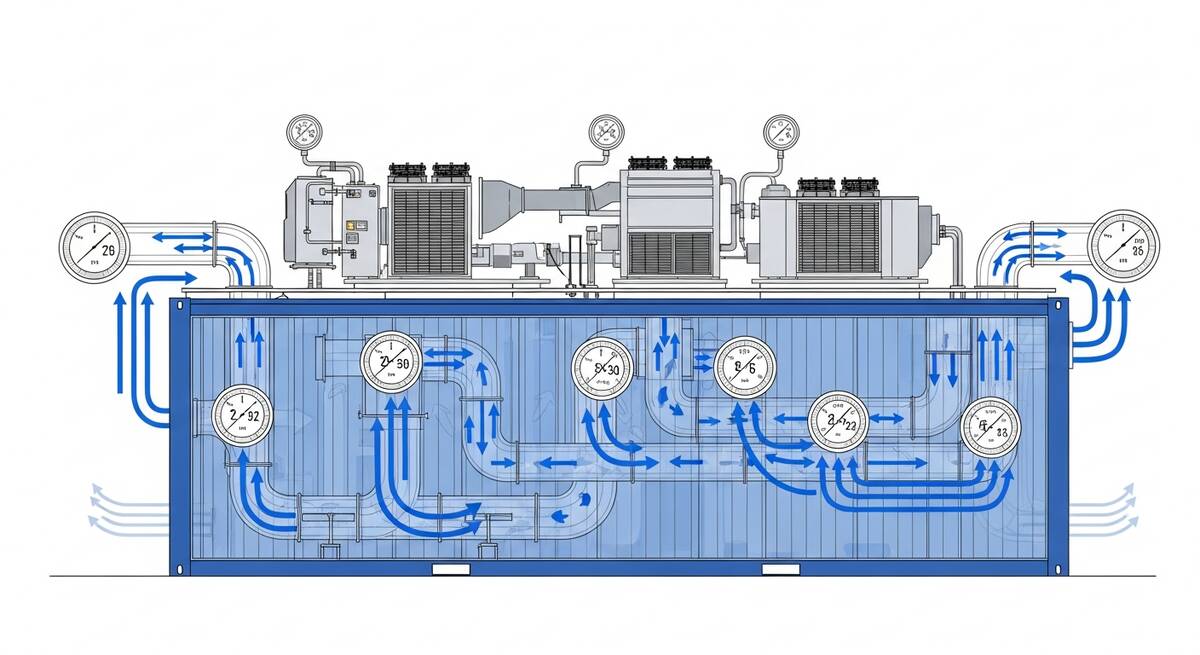
What is captured at the cupboard must go safely outside. The iron rule: laboratory extract from fume cupboards must not be run in recirculation. Recirculation into the room is not permitted where hazardous substances are present, because the pollutant concentration cannot be reliably cleaned to harmless levels. The standard is discharge over the roof (vertical discharge): thermal buoyancy and the vertical arrangement dilute the extract sufficiently, and re-entry into windows, doors or supply-air openings is avoided. Extract must also run continuously – including outside operating hours, so that nothing escapes.
DIN 1946-7 governs room-air technology for laboratories. The plant is to be designed so that an extract volume flow of at least 25 m³/h per square metre of laboratory floor area is not undershot; correspondingly more when working with very hazardous substances. To prevent hazardous substances migrating into neighbouring areas, the laboratory is also held at negative pressure relative to the surroundings. In the container that means in practice: an extract system with roof discharge, matching supply-air make-up, negative-pressure holding and – depending on the requirement – a redundant fan so that protection does not collapse on failure. Fire dampers in the extract ducts and alignment with the fire-safety concept belong with this; we cover that in more depth in the article on fire protection in the lab container.
Testing and operation: TRGS 526, annually, competent person
A fume cupboard is not a “fit and forget” device. Under TRGS 526 (Section 7.3) and the substantively identical DGUV Information 213-850, cupboards must be maintained regularly, their function tested and the result documented – at least once a year by a competent person. Overarching this, the Hazardous Substances Ordinance requires the employer to check the effectiveness of technical protective measures at least every third year; type, scope and intervals are set on the basis of the risk assessment and documented.
Items tested include in particular face velocity or volume flow, the function of the airflow monitor and alarm, the sash mechanism and the physical condition. On VAV cupboards the annual test of the control loop to Part 6 is added. Here the dividing line is clear: we deliver the cupboard ready for use, including the commissioning test – the recurring annual test and the risk assessment are organised by the operator. We name this division of duties from the outset so that no gap arises.
Conclusion: the cupboard is a system component, not a piece of furniture
A fume cupboard only protects when everything fits together: a type-tested unit with demonstrated containment, a ventilation plant that actually supplies the air required, extract discharge over the roof without recirculation, VAV control that tames the energy appetite, and a recurring test that secures function over the years. The cupboard is therefore not a piece of furniture that you put somewhere, but a system component that must be designed in from the first planning phase – in the container laboratory even more than in conventional construction, because here floor area and connection capacity are scarce.
Because our lab containers leave the Albstadt factory with matched ventilation plant, roof discharge, supply-air compensation and prepared services connections, cupboard engineering can be integrated cleanly – with documented commissioning and a clear chain of responsibility. Our planning and engineering service covers the design of cupboards, extract and room-air technology from a single source. How the entire path from idea to handover runs is shown in the article on the project process.
Plan cupboards and laboratory ventilation correctly from the start?
We design cupboard type, containment, extract discharge over the roof and the VAV energy concept together – delivered ready for use, with commissioning test and a clear chain of responsibility.
Request a free initial consultation